
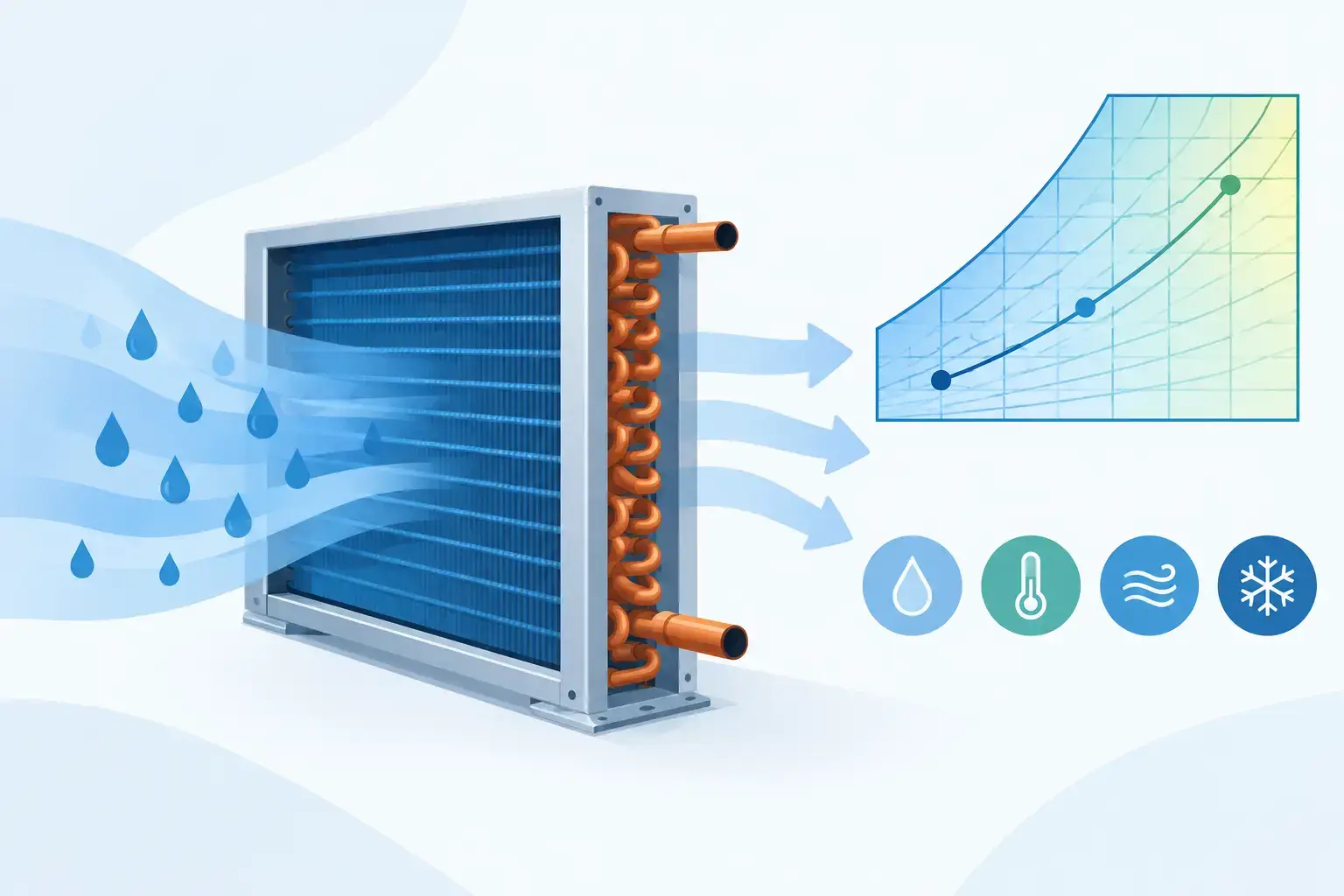
A cooling coil does not respond to dry-bulb temperature alone. Two entering-air conditions with the same dry bulb can produce materially different capacity, condensate, refrigerant mass flow, and leaving-air states. The difference is moisture content, and that is why an HVAC coil psychrometrics guide must begin with the air state rather than a nominal tonnage value.
For DX evaporators, psychrometrics connects air-side conditions to refrigerant-side performance. It defines the enthalpy change that establishes total capacity, the humidity-ratio change that establishes condensate removal, and the sensible-to-total relationship that influences coil selection and system control. Used correctly, it is not a chart-reading exercise. It is the air-side energy balance required to validate coil performance.
Start With the Complete Air State
At a minimum, air entering and leaving a coil should be defined by dry-bulb temperature, humidity ratio, and either relative humidity, wet-bulb temperature, dew point, or enthalpy. Pressure must also be specified. Standard sea-level pressure is often acceptable for preliminary work, but it is not interchangeable with actual site pressure when performance is being evaluated at elevation.
Dry-bulb temperature describes sensible condition. Humidity ratio, commonly expressed as grains per pound or pounds of water per pound of dry air, describes absolute moisture content. Relative humidity is useful for communicating comfort conditions, but it is not an energy property and should not be treated as a direct measure of latent load. The same relative humidity at different dry-bulb temperatures represents different humidity ratios and different enthalpies.
For coil analysis, enthalpy is usually the most efficient starting point. The air-side total cooling rate is:
`Qtotal = 4.5 × CFM × (hentering - hleaving)`
where enthalpy is in Btu/lb of dry air and capacity is in Btu/h. The 4.5 factor incorporates standard-air density and unit conversion. For engineering-grade calculations, particularly where airflow, altitude, or density depart from standard assumptions, calculate mass flow directly rather than relying on this convenience constant.
The sensible component is commonly approximated as:
`Qsensible = 1.08 × CFM × (Tentering - Tleaving)`
Latent capacity is then the difference between total and sensible capacity. This approach is practical, but it can obscure the underlying physics. A more rigorous method calculates moisture removal from dry-air mass flow and humidity-ratio difference, then applies the appropriate energy balance including condensate conditions.
The Coil Process on the Psychrometric Chart
An air stream passing through a wet cooling coil generally moves down and to the left on a psychrometric chart. It leaves colder and with a lower humidity ratio. The path is not arbitrary: it is governed by the entering air condition, coil surface temperature distribution, contact effectiveness, airflow, and refrigerant-side conditions.
If the coil surface is below the entering-air dew point, condensation occurs and the coil provides both sensible and latent cooling. If the surface remains above dew point, the process is sensibly cooling only. That distinction can change across the coil face. A coil operating near the entering-air dew point may have wet and dry regions simultaneously, especially under part-load conditions or with nonuniform refrigerant distribution.
The slope of the air process represents the sensible heat ratio, or SHR:
`SHR = Qsensible / Qtotal`
A high SHR indicates that most capacity is sensible. A lower SHR indicates a larger latent fraction. Neither value is inherently preferable. The required SHR depends on the application. A comfort-cooling coil in a humid climate, a low-temperature process coil, and a data-center air handler can have very different target air processes even at similar entering dry-bulb temperatures.
The chart is valuable because it makes these relationships visible. It is not, however, a substitute for a coil model. A psychrometric chart does not account for circuiting, fin geometry, refrigerant distribution, superheat, pressure drop, face velocity, or frost risk. It establishes the air-side thermodynamic target that the coil must achieve.
Apparatus Dew Point and Bypass Factor
Apparatus dew point, or ADP, is a useful construct for interpreting a cooling and dehumidification process. Extend the entering-to-leaving air process line until it intersects the saturation curve. That intersection is the theoretical effective surface condition represented by the coil process.
ADP is not necessarily the measured temperature of every tube, fin, or refrigerant circuit. Real coils have temperature gradients, dry areas, and nonuniform airflow. Still, it provides a practical way to relate leaving condition to coil contact effectiveness.
Bypass factor expresses the fraction of air that behaves as though it bypassed perfect contact with the effective coil surface. Using dry-bulb temperatures:
`BF = (Tleaving - TADP) / (Tentering - TADP)`
A lower bypass factor generally indicates stronger air-to-surface contact. It can result from greater coil depth, lower face velocity, more effective fin geometry, or other design changes that improve heat and mass transfer. The trade-off is not free. Additional rows and tighter fin spacing can increase air pressure drop, fan power, coil cost, and susceptibility to fouling.
Bypass factor also changes with operating condition. Treating it as a fixed catalog constant can be acceptable for a narrow rating range, but it becomes unreliable when airflow, refrigerant temperature, or entering humidity changes materially. For variable-speed equipment and wide application envelopes, the coil must be evaluated across the expected operating map.
Applying Psychrometrics to DX Evaporator Analysis
A DX evaporator links a changing refrigerant state to a changing air state. Refrigerant enters as a low-pressure two-phase mixture, absorbs heat through evaporation, and usually exits with superheat. Air entering the coil transfers sensible energy and, when the surface is wet, latent energy from condensed moisture.
The psychrometric air-side calculation should reconcile with the refrigerant-side heat balance within a defensible tolerance. A mismatch may indicate more than measurement error. It can expose incorrect airflow assumptions, invalid refrigerant property inputs, sensor placement problems, nonuniform face velocity, unaccounted duct heat gain, or an incorrect interpretation of saturated versus superheated refrigerant conditions.
Entering-air conditions matter as much as evaporating temperature. Increasing entering humidity ratio raises the latent opportunity when the coil is wet, but actual moisture removal still depends on effective coil surface temperature and contact. Lowering evaporating temperature can reduce ADP and increase dehumidification, yet it also changes compressor lift, capacity, efficiency, discharge temperature, and potentially frost behavior. The correct design point is an optimization problem, not simply the coldest possible coil.
Airflow introduces another coupled trade-off. Increasing airflow often improves air-side heat transfer and can raise sensible capacity, while shortening contact time and tending to increase bypass factor. Lower airflow can lower the leaving-air temperature and improve latent removal, but may reduce total airflow capacity, increase coil temperature glide effects, and create unacceptable pressure-drop or freeze-up concerns. Circuit design and refrigerant distribution determine whether the available surface is used effectively under those conditions.
Common Interpretation Errors
The first recurring error is using entering wet-bulb temperature as a complete description of air load. Wet bulb can be useful for rating and preliminary calculations, but it does not uniquely communicate every property needed for a complete engineering analysis without pressure and another air-state variable.
The second is calculating latent capacity from relative-humidity change. Relative humidity can rise across a coil even as moisture is removed because air temperature falls sharply. Humidity ratio, not RH, determines the mass of water removed from the air stream.
The third is assuming leaving air is saturated. Air leaving a well-designed cooling coil may be near saturation, but it is not universally saturated. Bypass air, coil-face nonuniformity, and dry coil regions can all produce leaving states below 100% RH. Forcing saturation can distort both calculated capacity and predicted condensate.
The fourth is comparing a rated coil condition with a field condition using only total capacity. A coil can deliver similar total capacity with very different sensible-latent splits. If the leaving humidity ratio does not meet the requirement, equivalent total capacity does not mean equivalent performance.
A Practical HVAC Coil Psychrometrics Workflow
Begin by defining entering air at the coil, not at a remote room thermostat or mixed-air estimate unless that condition has been validated. Record dry bulb, wet bulb or relative humidity, barometric pressure, airflow, and any return-outdoor air mixing assumptions. Determine humidity ratio and enthalpy from consistent psychrometric properties.
Next, define the required leaving-air condition or required load split. Calculate total capacity from enthalpy difference, sensible capacity from dry-bulb change, and moisture removal from the humidity-ratio difference. Condensate rate provides a useful physical check because it must align with the latent portion of the result.
Then evaluate whether the proposed coil and refrigerant operating condition can produce that process. Estimate ADP and bypass factor as diagnostic parameters, but validate them against a detailed coil model that represents geometry, circuitry, refrigerant distribution, heat transfer, and pressure drops. Professional HVAC&R software such as ExCoil is designed for this level of evaporator and condenser thermal analysis, where psychrometric targets must be reconciled with physical coil behavior.
Finally, test off-design conditions. Evaluate hot-dry air, hot-humid air, low-load operation, altered airflow, and expected refrigerant operating limits. A coil that meets one catalog point may not maintain humidity control, superheat stability, or acceptable pressure drop across the operating envelope.
Psychrometrics earns its value when it is treated as a design constraint tied to actual coil physics. Define the air state carefully, preserve the sensible-latent distinction, and use the resulting process as the standard against which the coil model is tested.