
Direct-expansion evaporator coils
DX evaporator coil design and rating software
Calculate cooling capacity, sensible heat ratio, outlet air state, superheat and refrigerant pressure drop for direct-expansion evaporator coils. Rate an existing coil, size a new one, or find the refrigerant flow that reaches the superheat you specify.
Calculator included in the free plan · The calculator interface is available in English and Portuguese.
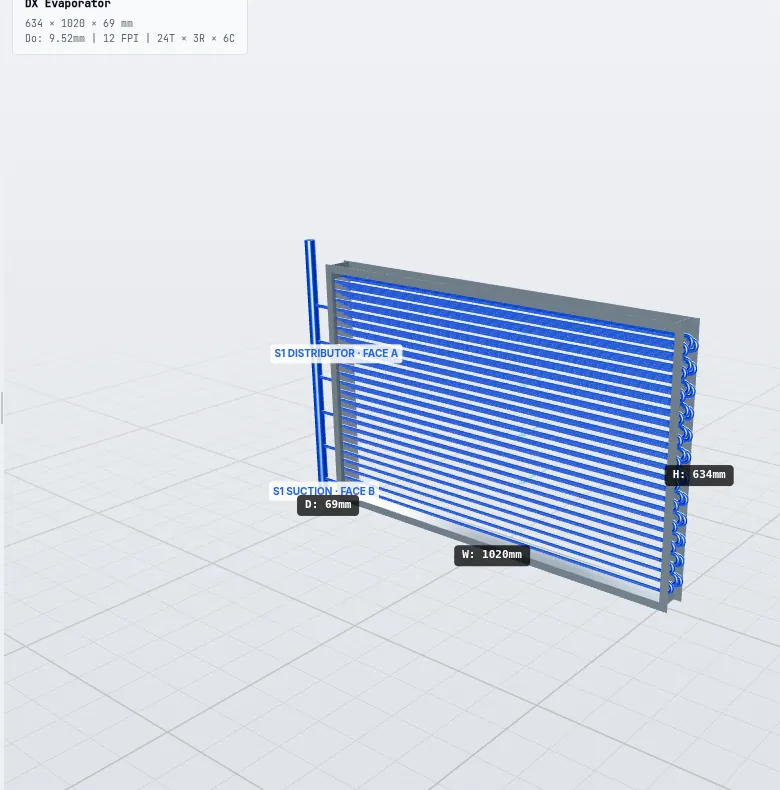
Real application screenshot
What it calculates
- Three modes: rating, sizing, and TXV mode that solves the refrigerant flow for a target superheat
- Dry and wet coil surface with dehumidification, sensible heat ratio and condensate
- Two-phase and superheated zones with pressure-coupled saturation temperature
- Refrigerant pressure drop in tubes and return bends, with saturation drop warnings
- Multiple refrigerant circuits, distributors and suction headers, including split systems
- Plain, wavy, louvered and slit fins; copper, aluminium, stainless steel and other materials
Results and deliverables
- Total and sensible capacity, SHR, outlet dry-bulb and wet-bulb
- Superheat reached, outlet phase, mass flux and saturation profile
- Air and refrigerant pressure drop, face velocity
- PDF technical report and CSV/JSON data (Professional)
- 2D drawing with DXF; 3D model with STL/STEP and circuitry designer (Enterprise)
How the evaporator model works
The coil is solved with a moving-boundary approach along the refrigerant path. The air side uses the Wang–Chi–Chang correlation with real fin thickness and Schmidt fin efficiency; the wet portion of the surface is treated by enthalpy potential. Saturation follows the local pressure, so a long circuit with a high pressure drop shows the capacity loss it really causes.
- Moving-boundary two-phase / superheated rating per circuit
- Wang–Chi–Chang (2000) air-side j and f factors
- Domanski–Hermes (NIST 2008) return-bend pressure drop
- Circuit-count optimum and hydraulic feasibility checks
- Psychrometrics per ASHRAE Fundamentals
Know the limits
- Wavy, louvered and slit fins use empirical enhancement factors over the plain-fin correlation, not dedicated correlations.
- Distribution between circuits is assumed uniform unless you apply a maldistribution factor.
- Results are estimates for selection and must be validated by test for catalogue ratings.
Frequently asked questions
Can ExCoil size a DX evaporator for a target superheat?
Yes. TXV mode searches the refrigerant flow that produces the superheat you request and reports when the circuits cannot pass that flow.
Which refrigerants are supported for evaporators?
Sixteen refrigerants with CoolProp-generated tables, including R410A, R32, R134a, R1234yf, R1234ze, R290, R404A, R407C, R507A, R744 and R717.
Does the calculation include dehumidification?
Yes. The model separates dry and wet surface and reports latent capacity, sensible heat ratio and outlet humidity.
Can I export the evaporator geometry to CAD?
Professional exports a 2D drawing in DXF. Enterprise adds a 3D model with STL and STEP export that includes the circuitry and headers.
Other modules
- Condenser coilDesuperheating, condensing and subcooling zones with real refrigerant enthalpies.
- Chilled water coilAHU cooling coils with dry/wet surface, glycol and real header sizing.
- Hot water coilHeating and reheat coils with water velocity and pressure drop checks.
- Steam coilIn-tube condensation, steam consumption and condensate sizing.
- Dry coolerWater and glycol fluid coolers with balanced sizing and V-shape layouts.
- Shell & tubeBell-Delaware, TEMA types, drawings, STEP, BOM and weights from one model.