
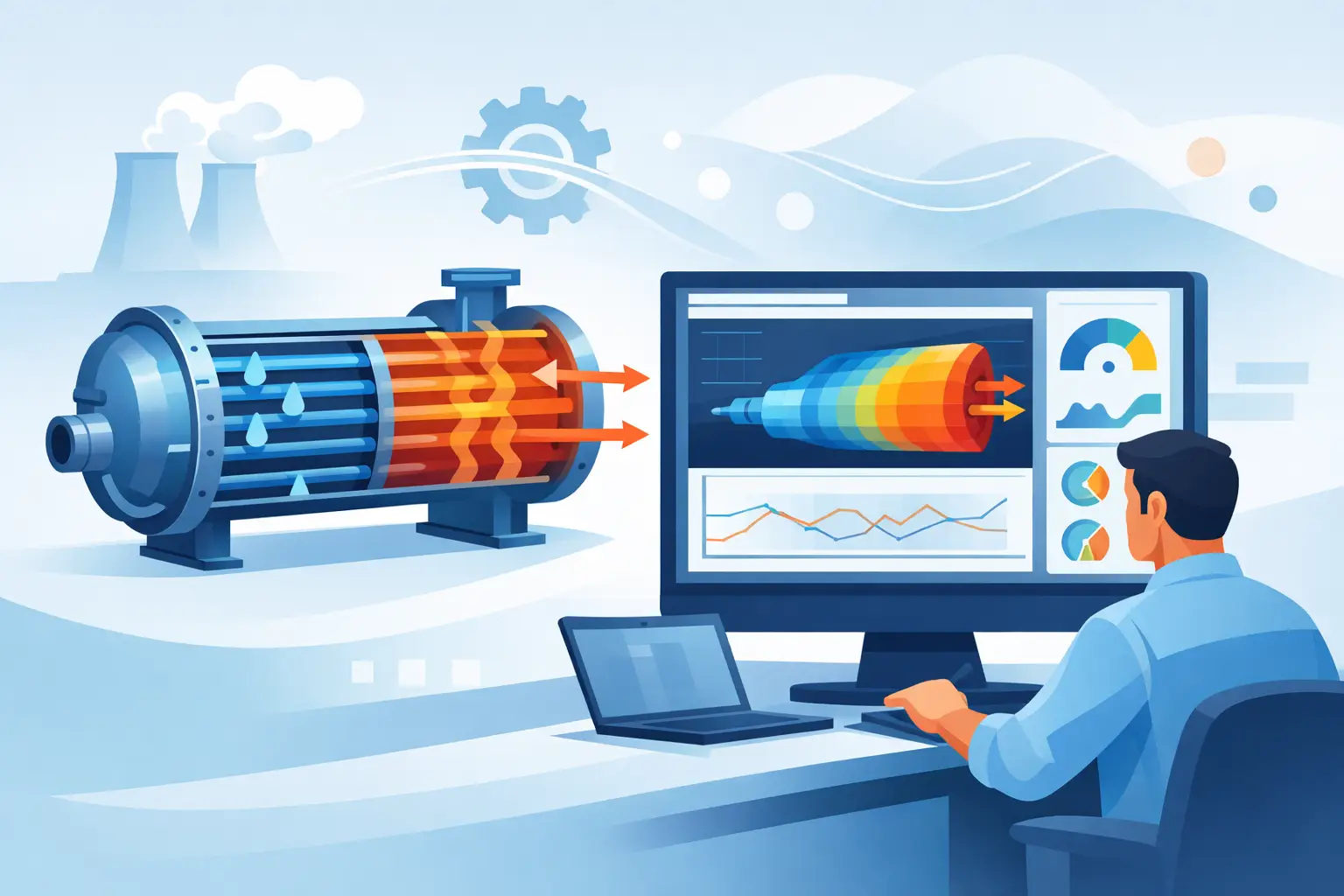
A condenser that looks acceptable on a rating sheet can still miss the mark once ambient conditions shift, refrigerant choices change, or circuiting assumptions prove optimistic. That is why condenser thermal analysis software matters in real engineering work. For OEM teams, coil designers, and HVAC&R engineers, the question is not whether a condenser can reject heat on paper. The question is whether the model reflects the actual thermal and refrigerant-side behavior closely enough to support design decisions.
What condenser thermal analysis software is supposed to do
At a professional level, condenser thermal analysis software should do more than return a capacity number. It should model how a condenser performs as a heat exchanger under defined operating conditions, including sensible cooling, latent effects where applicable, refrigerant state changes, pressure drop, and the interaction between airside and refrigerant-side performance.
That sounds straightforward until the inputs start to matter. Tube geometry, fin pattern, coil depth, row count, circuiting, refrigerant selection, airflow distribution, entering air temperature, condensing temperature, and subcooling targets all influence the result. A simplified calculator may be useful for quick screening, but it rarely provides enough resolution for product development or design validation.
Good software supports the engineering task behind the rating. It helps users compare coil configurations, test design sensitivity, and understand whether performance margins are real or simply artifacts of coarse assumptions.
Why generic tools often fall short
Many HVAC software platforms are built around equipment selection, field application, or business workflow. Those tools serve a purpose, but condenser analysis is a narrower problem. It requires heat exchanger-specific modeling rather than broad equipment administration.
The limitation shows up when technical users need more than a nominal output. If the software cannot represent detailed condenser geometry or refrigerant-side behavior with enough fidelity, the result may be acceptable for a sales estimate but weak for engineering judgment. That gap becomes expensive when a design moves into prototyping, lab testing, or production.
This is especially true in DX systems, where condenser performance influences head pressure, compressor operating conditions, system efficiency, and control stability. A small modeling error at the coil level can carry through the rest of the refrigeration system. For that reason, condenser thermal analysis software should be judged less by interface polish and more by calculation quality, input relevance, and repeatability.
What engineers should expect from condenser thermal analysis software
The most useful software is built around the actual variables engineers control. That means geometry-based inputs, refrigerant-aware calculations, and outputs that support design review rather than just marketing claims.
Geometry and construction detail
Condenser performance is tied directly to coil construction. Software should allow meaningful representation of tube diameter, tube spacing, fin spacing, fin type, number of rows, face area, and circuit arrangement. If these inputs are oversimplified, the resulting thermal prediction will be, too.
There is always a trade-off here. More detailed input improves model relevance, but it also demands better data discipline from the user. For engineering teams, that is usually a reasonable exchange. Precision depends on how closely the model matches the built coil.
Refrigerant-side analysis
A condenser is not just an airside heat transfer problem. Refrigerant-side calculations are central because phase change, mass flow, saturation conditions, and pressure losses affect heat rejection and downstream system behavior. Software should account for desuperheating, condensing, and subcooling regions rather than compressing the entire process into a single averaged result.
That matters when comparing designs across refrigerants or when evaluating how circuiting changes affect pressure drop and thermal distribution. Two coils with similar nominal capacity can behave quite differently once refrigerant-side losses are considered.
Airside performance and operating conditions
Airflow assumptions can distort results as much as refrigerant assumptions. Entering air temperature, face velocity, air distribution, and fouling assumptions all influence condenser output. In practice, airflow is rarely as uniform as early design models assume.
The right software helps quantify those dependencies instead of hiding them. Engineers need to know how much performance shifts when ambient rises, fan performance changes, or available airflow drops below the target point. That is where analysis becomes useful for risk reduction rather than simple rating.
Pressure drop and design trade-offs
Capacity alone is not enough. Condenser design usually involves trade-offs among heat rejection, airside pressure drop, refrigerant-side pressure drop, physical size, fan power, and manufacturability. Software should let users evaluate those trade-offs directly.
A larger coil may improve thermal performance but create packaging issues. Tighter fin spacing may increase capacity in clean conditions but degrade faster in dirty environments. More aggressive circuiting may improve one performance target while increasing refrigerant-side losses. Engineering-grade analysis makes these compromises visible early.
Where the software adds the most value
Condenser thermal analysis software is most valuable when it is used before physical testing, not after the design is already fixed. Lab validation remains necessary, but software reduces the number of iterations required to reach a workable design.
For OEM development teams, that means faster comparison of candidate coil geometries and clearer identification of design margins. For coil manufacturers, it supports quoting, design verification, and communication with customers who need more than catalog approximations. For consultants and advanced contractors working on performance-sensitive systems, it provides a basis for checking whether a proposed condenser selection aligns with the actual duty.
It is also useful during redesigns driven by refrigerant transition, footprint constraints, or performance upgrades. When one variable changes, the whole balance can move. Software helps show whether the new configuration still delivers acceptable condensing performance or whether secondary changes are required elsewhere in the system.
What separates engineering-grade software from a basic calculator
The distinction is not branding. It is whether the tool can support accountable technical decisions.
A basic calculator often assumes fixed coefficients, reduced geometry detail, or idealized operating conditions. That can be enough for rough screening. It is rarely enough for design validation. Engineering-grade thermal analysis software should provide calculation depth that aligns with professional HVAC&R workflows.
That includes transparent inputs, technically relevant outputs, and the ability to compare scenarios without rebuilding the entire model each time. It should also produce results that are credible in a design review setting, where engineers need to explain why one condenser option is preferable to another.
In this context, specialized tools have an advantage. Software focused specifically on DX evaporators and condensers can be structured around the actual decision points users face, rather than forcing coil analysis into a broader platform designed for unrelated tasks. That is the value of domain-specific software from providers such as ExCoil.
How to evaluate condenser thermal analysis software before adopting it
The first question is whether the software matches the level of engineering risk in your application. If you are screening concepts at a very early stage, a lighter tool may be acceptable. If you are validating product performance, supporting OEM development, or making decisions that affect efficiency, reliability, or compliance, the model needs more depth.
Next, look at input fidelity. If the software cannot represent the condenser you are actually building, the output has limited value. Geometry, circuiting, refrigerant conditions, and airside assumptions should be close to the real design space.
Then consider output usefulness. Engineers typically need more than total heat rejection. They need pressure drop, region-level thermal behavior, sensitivity to operating conditions, and data that can support trade-off analysis. Software that reports only a single capacity figure may save time initially but create uncertainty later.
Finally, assess fit with engineering workflow. A technically strong model still has to be practical to use repeatedly. Scenario comparison, revision control, and efficient input management matter because condenser design is iterative. The best software supports repeated analysis without encouraging shortcuts that degrade result quality.
The real benefit is better engineering judgment
No software eliminates the need for testing, and no model is perfect across every operating condition. Coil contamination, airflow maldistribution, manufacturing variation, and system-level interactions can still shift real performance away from prediction. But that does not reduce the value of analysis. It defines the standard the software must meet.
Condenser thermal analysis software is most useful when it improves judgment, not just speed. It should help engineers identify weak assumptions, compare design options on a technically sound basis, and reduce avoidable risk before hardware is built. When the tool is specialized, calculation-driven, and aligned with HVAC&R design work, it becomes part of the engineering process rather than an administrative convenience.
For teams working on condensers where performance accuracy matters, that difference is not minor. It is the difference between estimating a coil and actually understanding it.