
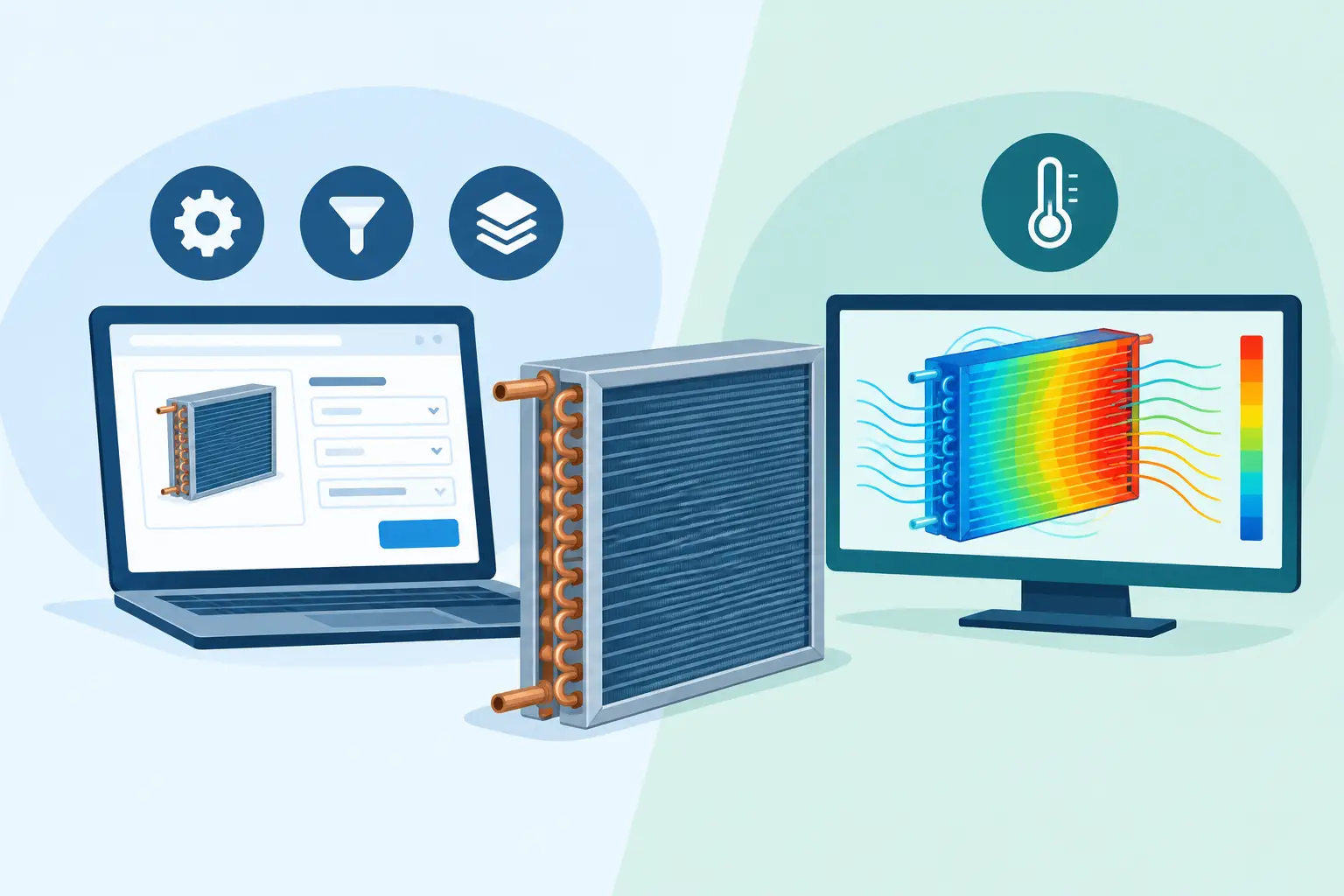
A coil selection that appears acceptable at catalog conditions can still create a system problem once circuiting, refrigerant distribution, fan operation, and actual entering conditions are considered. That is the practical distinction in selection tools vs thermal modeling: one identifies a plausible product or coil configuration quickly; the other evaluates whether the coil will perform as intended under the conditions that matter to the design.
For DX evaporators and condensers, the difference is not academic. Capacity, pressure drop, refrigerant-side heat transfer, air-side resistance, sensible heat ratio, leaving-air condition, and compressor operating point are coupled. A tool that treats those variables as fixed assumptions can be useful for an early decision. It cannot necessarily validate a design.
What a Selection Tool Is Designed to Do
A selection tool is built to narrow choices efficiently. It usually begins with a defined operating condition, such as airflow, entering-air dry-bulb and wet-bulb temperatures, refrigerant, target capacity, and perhaps a desired saturated suction or condensing temperature. The result is commonly a selected coil, nominal capacity, air pressure drop, face velocity, and one or more predicted leaving conditions.
That workflow has legitimate value. OEM application teams, distributors, and contractors often need a fast answer to a basic question: which available coil family or standard model is likely to meet this duty? When equipment is based on established product lines and the application stays close to published rating conditions, selection software can support timely quoting and preliminary equipment configuration.
The limitation is embedded in the purpose. Selection tools generally operate within a predefined product database and a controlled set of correlations, rules, or rating points. Their primary task is to select from known options, not to resolve the full local thermal behavior of a particular heat exchanger geometry and refrigerant circuit.
A selection result should therefore be treated as a decision input, not automatically as design validation. The distinction becomes more consequential when a coil departs from standard geometry, operates across a broad envelope, uses a nonstandard refrigerant, or must satisfy a tight performance margin.
Selection Tools vs Thermal Modeling: The Core Difference
Thermal modeling calculates coil performance from the physics and geometry that govern heat transfer. Rather than asking which catalog option best matches a requested capacity, it evaluates how the coil behaves as air and refrigerant move through it.
For a DX evaporator, that means resolving the changing refrigerant condition through the circuit, including two-phase evaporation, pressure loss, superheat development, and the interaction between local refrigerant temperature and air temperature. For a condenser, the calculation must account for desuperheating, condensation, subcooling where applicable, air-side heat pickup, and refrigerant-side pressure drop.
This matters because a DX coil is not thermally uniform. Air temperature and humidity change across the coil face and depth. Refrigerant quality changes along each circuit. Tube circuitry determines mass flux and affects both heat transfer and pressure drop. Distributor behavior and circuit arrangement can alter refrigerant allocation. A single nominal saturated temperature or overall UA value can obscure these effects.
An engineering-grade model divides the coil into calculation elements and tracks the relevant thermodynamic and transport behavior through those elements. The result is not merely a rating. It is an explanation of where capacity is produced, where pressure drop accumulates, how surface conditions evolve, and which design variables are driving the outcome.
Why Standard Ratings Can Mislead Design Decisions
Published ratings are necessary reference points, but they are not complete descriptions of coil capability. A rating may be generated at a prescribed airflow, entering-air condition, fan arrangement, refrigerant condition, and test methodology. In the field or in an OEM unit, those inputs often shift together.
Consider an evaporator evaluated at a higher face velocity than its nominal rating point. Air-side pressure drop rises, fan power may increase, and reduced residence time can change the air-side heat-transfer balance. If the entering-air latent load is substantial, surface temperature distribution also becomes important. A coil can meet a total-capacity target while missing a leaving-air humidity requirement.
Likewise, a condenser that satisfies capacity at one ambient condition may impose an unacceptable refrigerant pressure drop at another. The resulting increase in condensing pressure can affect compressor power, mass flow, discharge temperature, and system capacity. A simple selection may show adequate heat rejection without exposing that system-level penalty.
These are not failures of selection tools. They are questions outside the level of detail many selection tools are intended to answer.
Where Thermal Modeling Adds Engineering Value
Thermal modeling is most valuable when engineers need to make or defend a design decision rather than simply identify a product. It supports coil geometry development, circuit optimization, performance troubleshooting, and comparison of alternatives before hardware is built.
For coil designers, the ability to alter tube diameter, fin geometry, row count, circuit count, circuit pattern, face area, and airflow provides a direct path from a performance target to a manufacturable design. The analysis can show whether an apparent capacity gain comes with an air-side pressure-drop penalty, a refrigerant-side pressure-drop penalty, or a change in leaving-air conditions that the application cannot tolerate.
For product development teams, the same model enables parametric studies. An engineer can evaluate performance across ambient conditions, evaporating temperatures, condensing temperatures, airflow ranges, and refrigerant choices. This is especially useful where equipment must operate beyond a single design point, such as variable-speed systems, low-ambient applications, heat pumps, and refrigeration equipment with changing load profiles.
For troubleshooting, detailed modeling creates a reference against which test data can be interpreted. If measured performance differs from prediction, the investigation can focus on plausible causes: airflow distribution, actual circuiting, refrigerant charge, distributor performance, fouling, fan operation, or an inaccurate assumption in the test setup. A nominal selection result rarely offers the same diagnostic resolution.
Inputs Determine the Credibility of Any Result
Thermal modeling is not a substitute for sound engineering inputs. Higher-fidelity calculation does not correct uncertain geometry, unknown circuiting, poor airflow assumptions, or incomplete refrigerant data. It makes the consequences of those inputs more visible.
A useful model begins with accurate coil construction data: tube outside diameter and wall characteristics, fin type and spacing, tube pattern, row count, finned dimensions, circuitry, and material properties. Air-side conditions need more than a nominal CFM value when fan placement, bypass, recirculation, or nonuniform face velocity may be relevant. Refrigerant-side inputs should reflect the actual fluid, mass flow, inlet condition, and allowable pressure-drop constraints.
Engineers should also be explicit about boundary conditions. Is airflow fixed, or is it determined by a fan curve and system resistance? Is the refrigerant inlet condition known as pressure and enthalpy, or inferred from a broader system model? Is the coil clean, wet, frosted, or partially fouled? Each choice changes what the result means.
The correct objective is not a falsely precise number. It is a defensible prediction with assumptions that can be reviewed, tested, and refined.
When a Selection Tool Is Enough
A selection tool is often enough when the application uses a standard coil, established rating conditions, and a modest performance margin. It is also appropriate for early product screening, budget estimates, and quick comparison among catalog alternatives.
Thermal modeling is warranted when the design is custom, margins are narrow, operating conditions vary materially, or a performance shortfall would be costly. It is particularly valuable when circuiting must be developed, refrigerant pressure drop is a limiting factor, moisture removal matters, or the coil affects a compressor and fan operating point that cannot be treated independently.
The practical workflow is frequently sequential. Use selection to identify a reasonable design space, then use detailed analysis to validate the geometry and operating envelope. That approach retains speed without allowing a preliminary rating to become the final engineering answer.
Use the Tool That Matches the Decision
The question is not whether selection tools are useful or whether thermal modeling is always required. The question is what decision must be made, and what risk follows if the prediction is wrong.
For a familiar application with published equipment, a selection may be the right level of effort. For DX evaporator and condenser design, optimization, or performance assessment, engineering-grade thermal analysis provides the visibility needed to evaluate the actual trade-offs. ExCoil is built for that second task: turning coil geometry and operating conditions into technical evidence that can support a design decision.