
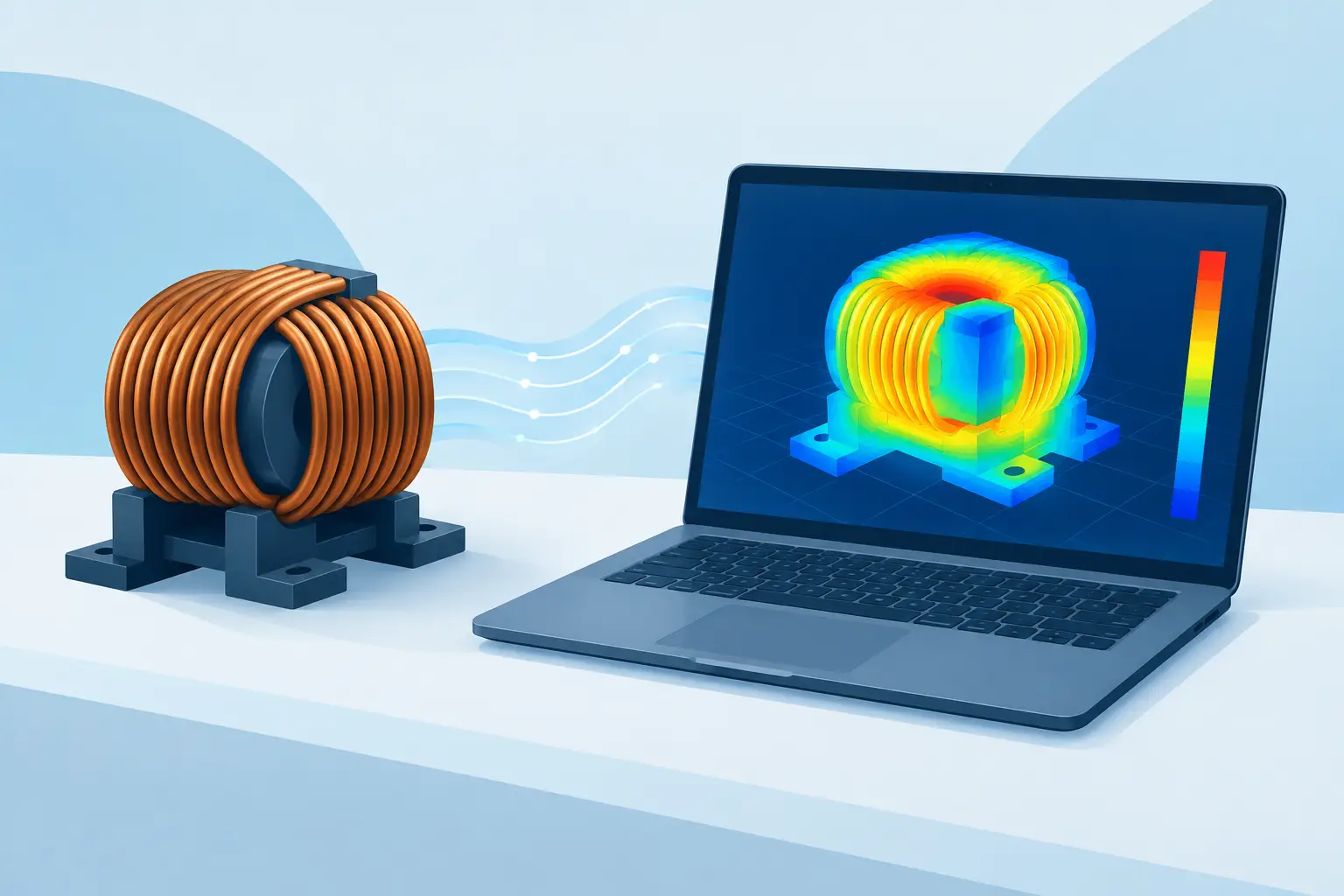
A DX coil rarely operates at its catalog rating point. Air temperature, humidity, airflow distribution, refrigerant conditions, circuitry, fin geometry, fan performance, frosting, and control logic all shift the result. Thermal digital twins provide a structured way to represent those interactions before a prototype is built, after a unit is commissioned, and when field performance no longer matches expectations.
For HVAC&R engineering teams, the value is not a generic visual model of equipment. It is a calculation framework that connects physical coil geometry and boundary conditions to measurable thermal performance. The quality of that connection determines whether the model helps a designer make a better decision or merely produces a convincing dashboard.
What Thermal Digital Twins Mean in HVAC&R
A thermal digital twin is a living computational representation of a thermal asset or component. For an evaporator or condenser, it should reproduce the governing heat-transfer and pressure-drop behavior across the operating envelope relevant to the equipment.
The word "living" deserves qualification. A twin does not need continuous cloud connectivity to be useful, nor does every coil require real-time sensor updates. In product development, the twin may be a calibrated design model used to evaluate circuitry, tube diameter, fin density, or refrigerant selection. In an operating system, it may ingest measured air and refrigerant conditions to estimate capacity, superheat, condensing behavior, or performance degradation.
The distinguishing feature is traceability to physics and data. Inputs should have a defined physical meaning, the model should expose its assumptions, and predictions should be compared with measured behavior when measurements are available. A model that cannot explain why capacity changed is limited as an engineering twin, regardless of how much data it displays.
The Coil-Level Physics That Matter
DX evaporators and condensers are distributed systems. Refrigerant state changes along each circuit, while air-side conditions change as air passes through the finned surface. Local heat-transfer coefficients, refrigerant pressure drop, air pressure drop, and surface temperature all interact. In an evaporator, latent load introduces an additional complication: moisture removal changes both the air state and the effective heat transfer process.
A useful coil twin therefore needs more than overall UA and a single entering and leaving temperature. It typically represents tube-and-fin geometry, circuit arrangement, refrigerant distribution, fin efficiency, air-side and refrigerant-side correlations, and the relevant phase-change regime. It also needs credible property calculations for the chosen refrigerant and the ability to resolve changing conditions through the coil.
At the system boundary, the model needs inputs that match the actual engineering question. These may include entering-air dry-bulb and wet-bulb conditions, airflow, refrigerant mass flow, inlet pressure and enthalpy, and fan operating point. For a condenser, ambient conditions, airflow, subcooling target, and condensing pressure may be central. For an evaporator, the expansion device and compressor response can become essential if the purpose is to predict system, rather than component, behavior.
This level of detail has a cost. More physical resolution requires more geometry, more reliable inputs, and more careful calibration. The appropriate model is not always the most detailed one. A concept-stage circuit comparison may require a different level of fidelity than a factory acceptance model or a field diagnostic application.
Where a Thermal Digital Twin Creates Engineering Value
The most immediate application is design validation. A coil design can meet nominal capacity while producing excessive refrigerant pressure drop, poor circuit balance, unacceptable face velocity, or a narrow operating margin at high ambient conditions. A twin allows these constraints to be evaluated together rather than discovered sequentially through prototype testing.
For OEM development teams, this supports faster iteration across variables that are costly to isolate experimentally. Engineers can test alternate circuit counts, tube patterns, fin configurations, refrigerant charge sensitivity, and airflow assumptions under a defined set of rating and off-design conditions. Physical testing remains necessary, but it can be focused on validating the decisions that matter rather than screening every early configuration.
The same approach supports root-cause analysis. If a field unit shows reduced capacity, a calibrated coil model can help separate several plausible mechanisms: low airflow, elevated entering-air temperature, a refrigerant-side restriction, altered condensing conditions, maldistribution, or fouling. The model does not eliminate the need for measurements. It identifies which measurements are most discriminating and whether the observed deviation is physically consistent with each failure hypothesis.
Digital twins also improve communication between coil design, refrigeration engineering, controls, and test teams. A documented model establishes a common basis for expected performance. Instead of debating whether a measured result "looks low," the team can compare it with predicted capacity, air-side pressure drop, refrigerant pressure loss, leaving-air state, and local operating limits at the same boundary conditions.
Building a Twin That Can Be Trusted
Trust begins with a clearly defined purpose. A model intended to select a coil at standard conditions should not automatically be used to diagnose a variable-speed refrigeration system in the field. Define the asset boundary, target outputs, operating envelope, required accuracy, and decisions the model will support before selecting its inputs or level of detail.
Geometry must be controlled with the same discipline as test data. Nominal tube rows and face area are not enough when circuiting, tube internal enhancement, fin pattern, return bends, distributor arrangement, or effective airflow area materially affect performance. If the geometry definition is incomplete, calibration can hide the error at one condition and fail badly elsewhere.
Calibration should use quality data over more than one operating point. Matching a single capacity test is a weak validation criterion because several compensating errors can yield the same total load. Better validation compares refrigerant-side pressure drop, air-side pressure drop, outlet air condition, saturation temperatures, superheat or subcooling, and capacity across a meaningful range of airflow and thermal conditions.
Measurement uncertainty must be visible. Airflow is frequently less certain than teams assume, especially where fan curves, external static pressure, bypass paths, or nonuniform velocity profiles are involved. Refrigerant mass flow, sensor placement, and psychrometric calculations also influence the comparison. A credible twin reports the uncertainty around its conclusions instead of presenting every output as an exact value.
Finally, maintain version control. When coil geometry, refrigerant, correlations, control logic, or sensor mapping changes, the twin has changed. Engineering teams need to know which model version supported a released design or a diagnostic recommendation. This is particularly important when performance claims are compared across prototype revisions.
Data Does Not Replace Thermal Analysis
There is a temptation to describe any telemetry platform as a digital twin. Trend data is valuable, but it is not by itself a thermal model. A historian can show that suction pressure changed. It cannot independently determine whether the change is caused by load, airflow, charge, valve behavior, or a coil-side restriction.
Conversely, a detailed physics model without representative operating data may be excellent for design work but weak for field prediction. The practical solution is a hybrid approach: engineering-grade thermal analysis establishes the physical structure, while test and operational data calibrate parameters, check validity, and reveal conditions that the original model did not anticipate.
Machine-learning methods can assist when they are applied within that structure. They may estimate difficult-to-measure inputs, detect residual patterns, or speed repeated evaluations. They should not be treated as a substitute for refrigerant distribution, phase-change behavior, or psychrometrics when those mechanisms govern the decision.
Selecting the Right Scope for Thermal Digital Twins
A coil-level twin is often the highest-value starting point because it addresses a component with substantial influence on capacity, efficiency, pressure drop, and control stability. It is also a manageable boundary for obtaining geometry and test data. ExCoil-style engineering-grade thermal analysis is particularly relevant where evaporator and condenser behavior must be resolved with more fidelity than a simplified equipment calculator can provide.
A system-level twin becomes appropriate when interactions with the compressor, expansion device, fans, and controls dominate the question. That expansion should be deliberate. Adding components without validated interfaces can create an apparently comprehensive model with less dependable outputs than a well-calibrated coil model.
The right next step is to choose one decision with measurable consequences: compare two circuit designs, verify a rating-point margin, explain a recurring capacity deviation, or quantify the impact of a new refrigerant condition. Build the twin around that decision, validate it against conditions that challenge it, and let the model earn a broader role through demonstrated predictive accuracy.