
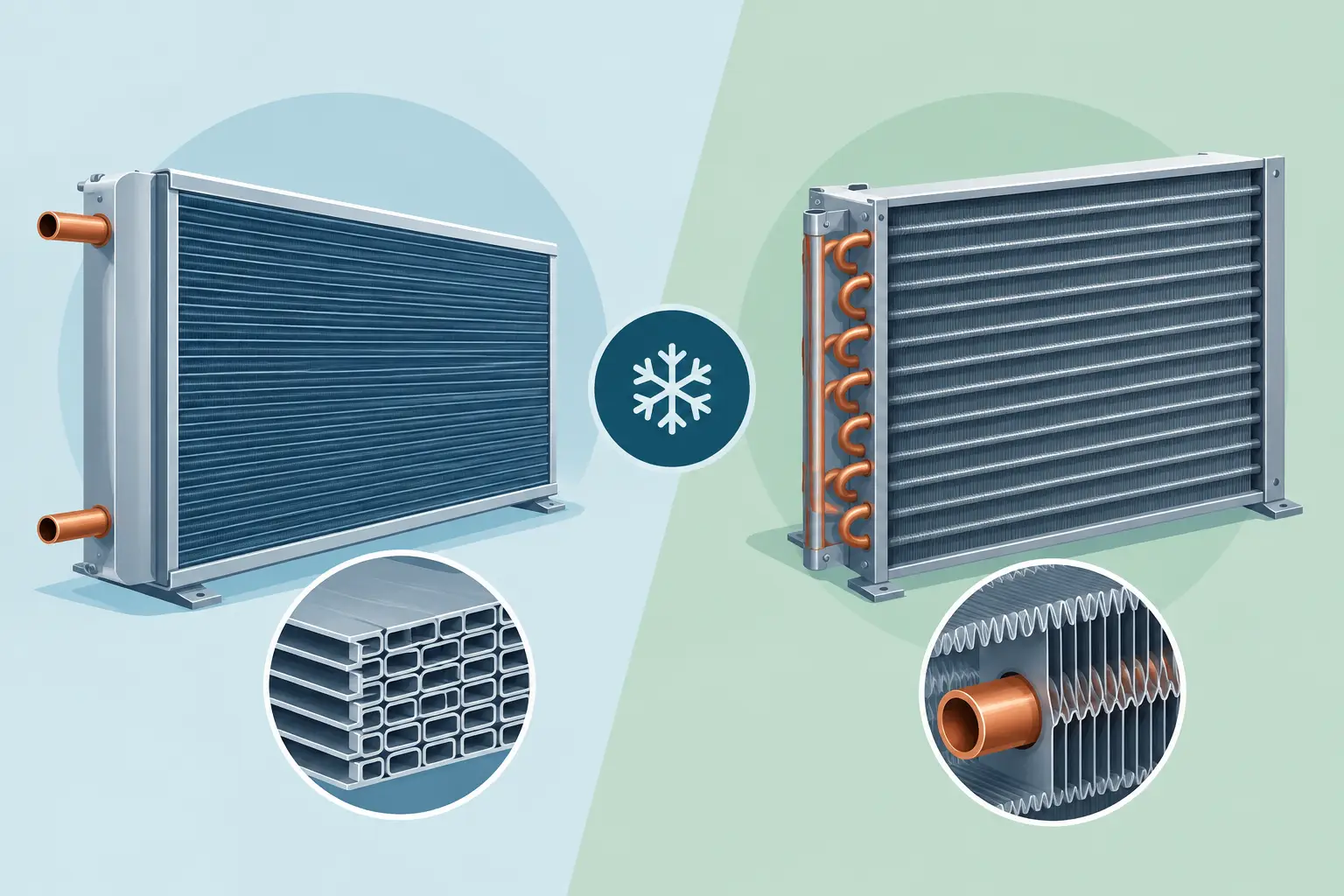
A condenser selection can alter refrigerant charge, fan power, cabinet depth, coil durability, and field-service exposure before the compressor or expansion device is even specified. For engineers evaluating microchannel versus finned tube condensers, the useful question is not which construction is universally better. It is which coil geometry produces the required capacity and operating margin under the actual airside, refrigerant-side, manufacturing, and service conditions.
Microchannel and finned tube coils can both deliver effective condensing performance. Their differences become meaningful when the design must meet a constrained footprint, low-charge target, difficult ambient condition, corrosion requirement, or repairability expectation. A valid comparison requires more than nominal capacity at one rating point. It requires coil-level thermal and hydraulic analysis across the operating envelope.
Microchannel Versus Finned Tube Condensers: Construction
A microchannel condenser typically uses flat, extruded aluminum tubes containing multiple small refrigerant ports. These tubes are brazed to headers and joined by louvered aluminum fins in a compact core. Refrigerant is distributed from a header into parallel flow paths, often with multiple passes arranged to control pressure drop and refrigerant distribution.
A finned tube condenser generally uses round copper tubes mechanically expanded into aluminum fins, although other material combinations are possible. U-bends, return bends, distributors, and headers establish the refrigerant circuit. Tube diameter, fin pitch, tube row count, circuiting, and face area provide a broad design space. This construction has a long application history in unitary air conditioning, refrigeration, heat pumps, and custom condensing equipment.
The material and geometry differences drive the comparison. Microchannel designs can place a large heat transfer surface within a shallow depth and maintain a low internal refrigerant volume. Finned tube coils offer more circuiting flexibility and are often more forgiving in applications where field repair, coil replacement, or nonstandard geometry matters.
Capacity Is a Coil-Level Result
It is tempting to assign a fixed capacity advantage to one construction. That approach is not reliable. Condensing capacity depends on the overall conductance, or UA, and on the temperature difference available between condensing refrigerant and entering air. UA is affected by airside and refrigerant-side heat transfer coefficients, fin efficiency, tube-wall resistance, contact resistance, coil surface area, airflow distribution, and fouling.
Microchannel coils can achieve high airside heat transfer because louvered fins create repeated boundary-layer disruption. The flat tubes also provide favorable heat transfer area relative to core volume. For equipment where depth and refrigerant charge are tightly constrained, this can produce a substantial packaging advantage.
However, high louver density does not automatically translate to higher installed capacity. Airside pressure drop rises with fin geometry, face velocity, contamination, and coil depth. If the fan must overcome higher external static pressure, fan power and airflow may change enough to affect net system performance. Uneven airflow across a condenser face can also reduce the effective value of a high-performance fin geometry.
Finned tube condensers can be designed with larger face areas, lower face velocities, variable fin spacing, and multiple row arrangements. These options are valuable for air-cooled equipment exposed to cottonwood, dust, grease, or other debris. A lower fin density may sacrifice compactness but can preserve airflow and capacity over a longer service interval.
Thermal analysis should therefore evaluate capacity at the intended ambient range, airflow rate, condensing temperature, subcooling target, and refrigerant condition. It should also account for fan curve interaction rather than treating airflow as a fixed input. Professional HVAC&R software is particularly valuable when alternative circuitry and geometry must be compared under the same boundary conditions.
Refrigerant Charge and Pressure Drop
Low internal volume is one of the defining advantages of microchannel condensers. Reduced condenser volume can lower system refrigerant charge, which may support cost, regulatory, and safety objectives. This benefit is especially relevant when refrigerant inventory is constrained or when charge reduction improves product economics.
The trade-off is that the small hydraulic passages require disciplined refrigerant-side design. Port dimensions, pass arrangement, header geometry, quality distribution, and mass flux affect pressure drop and phase distribution. Inadequate distribution can leave portions of the coil underutilized while other paths experience excessive pressure loss. The consequence is lost capacity, reduced subcooling, or unstable performance under part-load conditions.
Finned tube condensers usually have larger refrigerant passages and greater internal volume. They may tolerate certain contaminants or oil circulation conditions better, although that does not remove the need for proper system cleanliness. Their larger volume generally increases charge, but the circuit designer has extensive control over tube diameter, number of parallel circuits, and path length.
Neither approach should be selected from volume alone. A lower charge coil that causes excessive condensing pressure or insufficient liquid subcooling may not improve the system result. Conversely, a finned tube coil with more volume may be appropriate when its lower refrigerant-side pressure drop, circuit flexibility, or operating stability creates a better system balance.
Airside Fouling, Corrosion, and Durability
Field conditions often determine whether a theoretically compact coil remains a good choice over its service life. Microchannel condensers are sensitive to external fin damage because their thin, closely spaced louvered fins can be difficult to straighten without restricting airflow. Surface debris may bridge the fin structure, and cleaning methods must avoid deforming fins or driving contaminants deeper into the coil.
All-aluminum microchannel construction avoids the copper-to-aluminum material pairing found in many finned tube coils. That can reduce some galvanic corrosion concerns at the tube-fin interface. It does not make the coil immune to corrosion. Coastal salt exposure, industrial pollutants, trapped moisture, and incompatible cleaning chemicals can still degrade aluminum components. Coating selection and coating-process quality should be assessed for the specific environment.
Finned tube coils also require corrosion evaluation, especially where copper tubes, aluminum fins, coatings, and support structures are exposed to aggressive atmospheres. Their comparatively open fin patterns can be easier to inspect and clean, and bent fins can often be combed in the field. For remote equipment or installations where cleaning practices are inconsistent, that service tolerance may outweigh a compact-core advantage.
Mechanical durability is similarly application-specific. Shipping vibration, hail exposure, panel protection, coil guards, and installation access all affect the appropriate construction. A coil should be considered as part of the complete outdoor section, not as an isolated laboratory specimen.
Serviceability and Manufacturing Risk
Finned tube condensers are widely familiar to service technicians. Individual tubes can sometimes be isolated, repaired, or replaced depending on the failure location and equipment design. This does not mean repair is always economical, but the field-service path is well understood.
Microchannel coils are generally more difficult to repair reliably after a leak or physical damage. Their brazed aluminum construction, small ports, and header geometry often make replacement more practical than localized repair. For OEMs, that changes the risk calculation: a microchannel coil may reduce material use and cabinet size, while a finned tube coil may reduce lifecycle exposure where repairability is a contractual or operational priority.
Manufacturing capability also matters. Microchannel performance depends on controlled brazing, clean internal passages, effective header design, and repeatable refrigerant distribution. Finned tube production has its own quality requirements, including tube expansion quality, circuit integrity, and fin-to-tube contact, but it is often easier to adapt to custom coil sizes and specialized circuiting.
Model the Operating Envelope, Not a Single Rating Point
A valid condenser comparison should include more than rated capacity and initial cost. Evaluate condensing pressure, refrigerant pressure drop, subcooling, airside static pressure, fan operating point, charge, coil mass, and expected degradation from fouling. For heat pump equipment, include heating-mode consequences as well, because the outdoor coil must satisfy different thermal duties across the annual operating range.
The refrigerant matters. Pressure level, saturation-temperature glide, mass flow rate, oil behavior, and allowable charge can shift the preferred circuit design. So can control strategy. Variable-speed compressors and fans may expose distribution or pressure-drop issues that are not apparent at a single full-load condition.
For each candidate coil, calculate performance at high ambient, nominal rating, reduced airflow, and representative part-load conditions. If the product will operate in contaminated or corrosive locations, include practical allowances for fouling and airflow degradation. The resulting decision will be more defensible than one based on coil depth or a catalog capacity alone.
A microchannel condenser is often compelling when compactness, low charge, and carefully controlled manufacturing are primary objectives. A finned tube condenser can be the stronger engineering choice when circuit flexibility, serviceability, field cleanability, or application-specific geometry carries greater weight. The productive next step is to model both options against the same system requirements, then select the coil that preserves performance margin where the equipment will actually operate.