
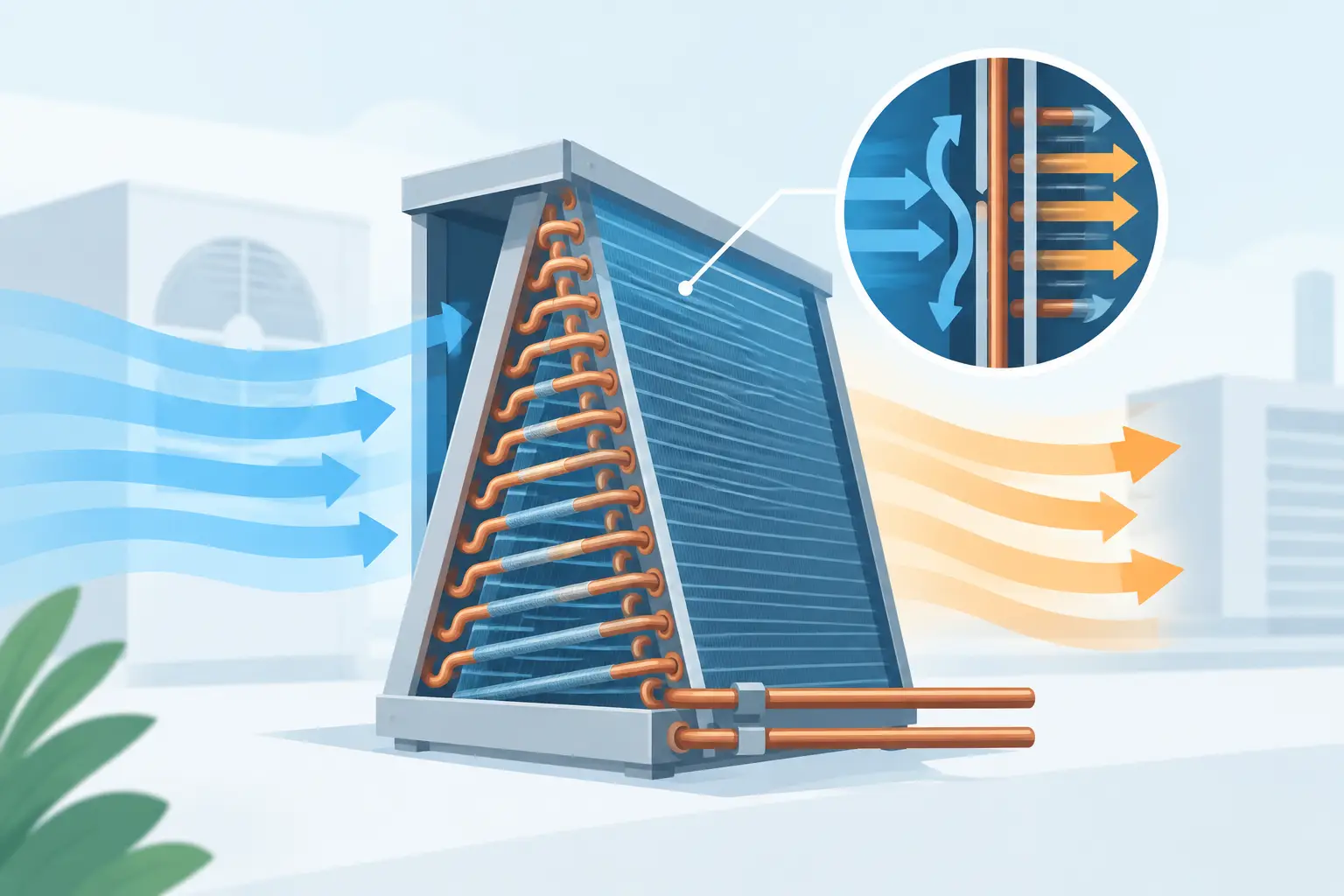
What is coil bypass factor? It is a compact way to describe how closely air leaving a cooling coil approaches the coil’s effective surface condition. For an HVAC&R engineer, that makes it far more than a catalog value. Bypass factor directly affects predicted leaving-air temperature, dehumidification, sensible heat ratio, coil face area, and the confidence behind a DX evaporator selection.
A real coil does not bring every air particle into perfect thermal and moisture contact with its cold surface. Some air passes through with limited contact, while other air streams approach the surface temperature much more closely. Coil bypass factor represents the fraction of the entering-air-to-coil-surface condition difference that remains in the leaving air.
What Is Coil Bypass Factor?
Coil bypass factor, usually expressed as BF, is the ratio of the leaving-air temperature difference to the entering-air temperature difference relative to the apparatus dew point (ADP):
`BF = (T_leave - T_ADP) / (T_enter - T_ADP)`
Where `T_enter` is entering-air dry-bulb temperature, `T_leave` is leaving-air dry-bulb temperature, and `T_ADP` is the apparatus dew point temperature.
The apparatus dew point is the effective saturated condition of the coil surface as represented on a psychrometric chart. It is not necessarily the refrigerant saturation temperature, nor is it a single measured metal temperature at one location on the coil. It is a useful analytical construct that allows the air-side process to be represented by a line between entering air and an ideal saturated coil-surface condition.
A lower bypass factor means the leaving air is closer to ADP. A higher bypass factor means more of the entering-air condition remains in the discharge air.
For example, consider air entering a cooling coil at 80°F dry bulb with an ADP of 50°F. With a bypass factor of 0.10, the estimated leaving-air dry bulb is:
`T_leave = 50 + 0.10 × (80 - 50) = 53°F`
At a bypass factor of 0.25, leaving dry bulb rises to 57.5°F. That 4.5°F difference can materially change sensible capacity, supply-air performance, and downstream humidity control.
Bypass Factor and the Leaving-Air State
For a wet cooling coil, bypass factor applies to the full psychrometric process, not dry-bulb temperature alone. The leaving-air state falls along the straight line between the entering-air state and the ADP on a psychrometric chart. The same proportional relationship can be expressed using humidity ratio:
`BF = (W_leave - W_ADP) / (W_enter - W_ADP)`
In an idealized coil process, dry-bulb temperature, humidity ratio, and enthalpy all move toward the ADP condition by the same fractional amount. This is why bypass factor is useful for estimating both sensible cooling and moisture removal.
However, the result depends on a valid representation of the coil process. If the coil is partially wet, has uneven refrigerant distribution, operates with significant face velocity variation, or experiences nonuniform entering-air conditions, a single ADP and BF may not fully describe the coil. The parameter remains valuable, but it should not be treated as a substitute for detailed heat exchanger modeling.
Contact Factor Is the Complement
Contact factor is simply the complement of bypass factor:
`Contact Factor = 1 - BF`
A coil with a 0.12 bypass factor has a 0.88 contact factor. In practical terms, the model assumes 88% effective contact between the air stream and the coil surface process, while 12% of the entering-condition difference bypasses that ideal contact.
Contact factor can be intuitive when discussing coil effectiveness. Bypass factor is generally more common in psychrometric coil calculations because it directly supports leaving-air calculations from a known entering condition and ADP.
What Determines Coil Bypass Factor?
Bypass factor is not a fixed property of a coil model. It changes with geometry, airflow, and operating condition. A published rating condition may provide a useful starting point, but applying that value outside the rating envelope can introduce error.
The strongest influences include:
- Face velocity: Higher air velocity generally reduces air-side residence time and increases bypass factor. Lower face velocity usually improves approach to ADP, although it can increase coil size and air-side pressure drop considerations.
- Number of rows and air-side depth: More rows increase heat transfer surface and contact opportunity, typically lowering bypass factor.
- Fin geometry and surface area: Fin spacing, fin pattern, tube arrangement, and effective external area influence air-side heat transfer and the coil’s approach to ADP.
- Refrigerant-side distribution: Uneven circuit loading, maldistribution, and varying local refrigerant temperatures create nonuniform surface conditions that can degrade actual coil performance.
- Wet-surface behavior: Condensate retention, fin wetting, and local dry-to-wet transitions affect heat and mass transfer. These effects matter particularly when latent capacity is a primary design requirement.
For a simplified sensible heat exchanger, bypass factor is often related conceptually to an exponential effectiveness term, such as `BF ≈ exp(-NTU)`. That relationship is useful for intuition, but a DX evaporator requires more care. Refrigerant pressure drop, circuiting, superheat development, local saturation temperature, and coupled air-side heat and mass transfer all influence the actual leaving-air condition.
Why Bypass Factor Matters in DX Evaporator Selection
A coil can meet total capacity and still miss the required leaving-air condition. This is one reason bypass factor deserves attention during design validation.
At a given total load, a coil with a lower bypass factor generally produces colder, drier discharge air because it drives the air state closer to ADP. That can improve latent capacity and lower supply-air dew point. The trade-off may be greater coil depth, lower face velocity, more heat transfer surface, or a different refrigerant circuit arrangement.
Conversely, a higher bypass factor can be acceptable when sensible cooling dominates and a warmer leaving-air temperature is desirable. It may also result from constraints on coil dimensions, fan power, pressure drop, or cost. There is no universally correct bypass factor. The appropriate value depends on the load profile, ventilation rate, humidity target, system airflow, and available coil envelope.
For comfort cooling, bypass factor affects how well a system maintains indoor humidity at part load and design latent conditions. For refrigeration or process cooling, it affects product-space temperature control, moisture management, and the risk of operating outside a specified discharge-air range. In both cases, using a generic BF value without checking the actual operating point can conceal a meaningful performance risk.
Using Bypass Factor in Engineering Calculations
A preliminary calculation commonly begins with entering-air dry bulb and humidity, a target ADP, and an assumed or manufacturer-derived bypass factor. The calculated leaving condition can then be used to estimate airflow-side capacity and sensible heat ratio.
That approach is appropriate for early sizing, hand checks, and psychrometric validation. It becomes less reliable when the coil operates far from its rated airflow, entering condition, or refrigerant condition. A BF derived at one face velocity should not automatically be applied at another. Likewise, changing the evaporating temperature changes the coil surface condition and may change the wetness distribution across the coil.
Professional HVAC&R software provides more defensible results when it models the coil as a distributed heat exchanger rather than as a single ADP point. For DX evaporators, engineering-grade thermal analysis can account for circuit geometry, refrigerant properties, pressure losses, local air conditions, superheat progression, and air-side performance. In that context, bypass factor remains a useful output and diagnostic indicator, rather than the sole basis for the calculation.
Common Interpretation Errors
One frequent error is treating ADP as the refrigerant evaporating temperature. The two may be related, but they are not interchangeable. Thermal resistance through the tube wall, fin material, refrigerant-side film, and air-side film means the effective air-side apparatus dew point is usually warmer than the local refrigerant saturation temperature.
Another error is assuming a low bypass factor always indicates a better coil. A very low BF can support strong latent performance, but the resulting coil may impose added air pressure drop, require more face area, or create control challenges under reduced airflow. The performance objective must govern the selection.
It is also risky to calculate humidity removal from dry-bulb temperatures alone. Latent performance requires the entering-air moisture condition and a valid psychrometric path to ADP. Two coils can produce similar leaving dry-bulb temperatures while delivering different dehumidification results if their effective surface conditions differ.
A Useful Design Check
When reviewing a DX coil selection, compare the predicted leaving-air state with the required supply-air temperature and dew point, then examine the implied ADP and bypass factor at the actual design airflow. If the values shift substantially between rating and application conditions, the coil warrants a more detailed thermal analysis.
Bypass factor is most useful when treated as evidence of the underlying air-to-refrigerant heat transfer process. Used that way, it helps engineers identify whether a coil is merely meeting a capacity number or actually delivering the leaving-air condition the equipment must achieve.