
A coil selection can shift compressor sizing, fan power, refrigerant charge, cabinet geometry, and field-maintenance exposure at the same time. The microchannel versus tube fin coils decision is therefore not a material substitution exercise. It is a heat exchanger architecture decision that must be evaluated at the rated condition, across the operating envelope, and against manufacturing and service constraints.
For DX condensers and evaporators, neither construction is universally superior. Microchannel coils can deliver high compactness and low internal volume. Tube fin coils retain substantial advantages where circuit flexibility, repairability, frost tolerance, or application-specific optimization govern the design. The correct choice follows from thermal duty, airside conditions, refrigerant distribution, allowable pressure drop, and expected lifecycle environment.
Microchannel Versus Tube Fin Coils: The Fundamental Difference
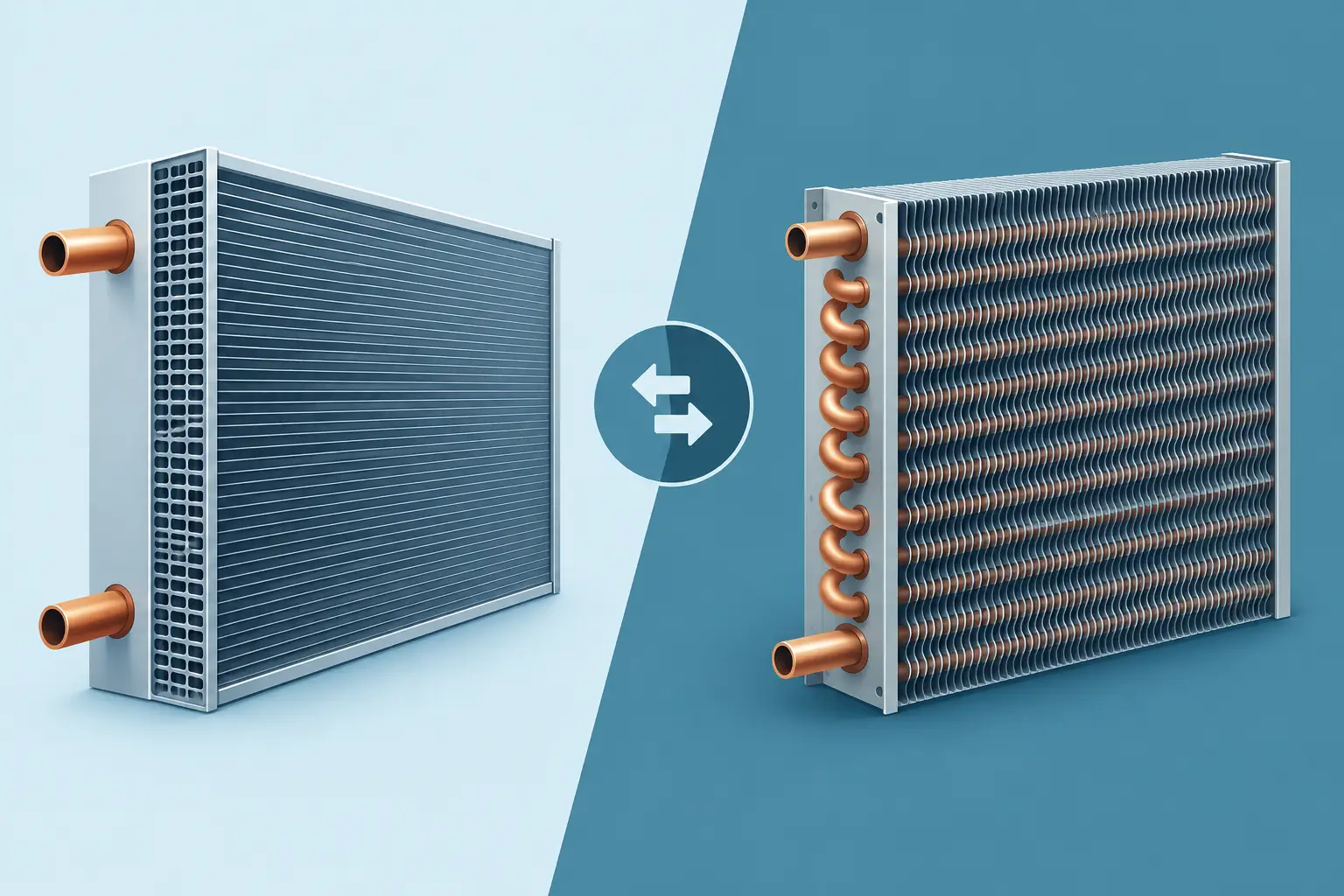
A conventional tube fin coil uses round or oval tubes expanded or mechanically bonded to plate fins. Refrigerant moves through one or more tube circuits while air passes across the fin pack. Designers can vary tube diameter, row count, tube spacing, fin pitch, circuiting, fin geometry, and distributor arrangement over a broad range.
A microchannel coil typically uses flat, multiport extruded tubes joined to headers, with louvered fins between the tubes. Refrigerant flows through multiple small parallel ports within each flat tube. The airside surface is compact, and the refrigerant-side volume is usually much lower than that of a comparable tube fin design.
That geometry changes more than physical dimensions. It changes local heat transfer coefficients, airside pressure loss, refrigerant pressure drop, charge inventory, distribution sensitivity, and failure modes. Comparing only face area or nominal capacity misses the engineering problem.
Capacity Is a UA and System Question
At coil level, capacity depends on the available heat transfer conductance, temperature difference profile, airflow, refrigerant-side behavior, and sensible-to-latent duty where applicable. A compact microchannel condenser can achieve high capacity per unit volume because louvered fins create a large effective airside area and strong airside heat transfer. Its low refrigerant volume also reduces the amount of refrigerant required to fill the coil.
However, high nominal capacity density does not automatically produce better system performance. The airside pressure drop must be matched to the fan and enclosure. Louver geometry can provide excellent heat transfer but may impose a meaningful fan-power penalty if face velocity, fin density, or contamination allowance is poorly selected. Performance should be compared at equal airflow and external static pressure, not at an arbitrary airflow point.
Tube fin coils provide more geometric degrees of freedom. A designer can add rows, adjust fin spacing, revise tube circuitry, use enhanced tubes, or alter face area without adopting a different header-and-port architecture. This flexibility can be valuable for OEM platforms that must accommodate multiple capacities, refrigerants, and ambient ranges using related tooling and cabinet designs.
For either coil type, engineering-grade analysis should resolve refrigerant properties and pressure loss along the circuit rather than apply a single average heat transfer coefficient. This is particularly relevant when a coil operates near a phase-transition boundary, at high compression ratio, or with significant glide.
Refrigerant Distribution Has Different Risks
Microchannel circuits can be highly sensitive to maldistribution. Because the ports and parallel flow paths are small, uneven inlet quality or mass flux can leave portions of the heat exchanger underfed or overloaded. Header design, inlet geometry, orientation, tube count, and refrigerant state entering the coil all affect distribution.
For condensers, uneven distribution can alter desuperheating, condensation, and subcooling allocation across parallel paths. For evaporators, it can create nonuniform superheat, uneven surface temperature, and capacity loss. The resulting performance deviation may not be apparent from a simplified rating calculation.
Tube fin evaporators also require careful distributor design, particularly with multiple circuits and low-load operation. Their larger flow passages and more familiar distributor architectures can be more tolerant in some applications, but tolerance should not be assumed. Circuit pressure drop, distributor nozzle selection, feeder geometry, and circuit loading remain central to evaporator performance.
Charge Reduction Is Valuable, but It Is Not the Only Metric
Low internal volume is one of the most compelling reasons to consider microchannel technology. Reducing refrigerant charge can lower direct refrigerant emissions risk, support regulatory objectives, and improve economics when refrigerant cost is material. It can also reduce the refrigerant inventory that must be managed during manufacturing and service.
Yet a lower coil charge must be assessed at system level. Receiver requirements, accumulator volume, line-set volume, oil circulation, startup transients, and control stability can determine whether the system realizes the expected charge reduction. In a reversible heat pump, the behavior of the coil in both heating and cooling modes must be modeled rather than inferred from cooling-only data.
Tube fin coils typically require more internal refrigerant volume, especially in multi-row designs. That can be a disadvantage in charge-constrained equipment. It can also provide practical circuiting and control flexibility in systems where refrigerant inventory is not the primary design constraint.
Airside Fouling, Frost, and Drainage Change the Answer
Clean-coil performance is necessary for rating, but field performance determines product value. Microchannel coils often use closely spaced louvered fins that can be susceptible to airborne debris, cottonwood, grease, or mineral deposits, depending on the installation. Cleaning methods must be selected carefully because aggressive brushing or high-pressure washing can deform fin structures.
Tube fin coils can also foul, especially at tight fin pitch, but their construction may be more familiar to service organizations and easier to clean in certain installations. The appropriate fin spacing depends on the exposure. A coil designed for a clean, controlled indoor airstream should not be evaluated by the same fouling assumptions used for a rooftop unit near vegetation or an industrial process environment.
For evaporators operating below freezing, frost growth deserves separate analysis. Fin pitch, tube arrangement, surface-temperature distribution, drainage paths, and defrost method govern the useful interval between defrost events. A compact coil with strong clean performance may lose its advantage if frost bridges fins early or blocks airflow rapidly. Tube fin geometry can offer practical advantages in freezer and heat-pump applications where frost accumulation is a dominant duty-cycle variable.
Corrosion and Serviceability Are Lifecycle Design Inputs
Many microchannel coils are aluminum constructions, which can offer material and manufacturing advantages but require a deliberate corrosion strategy. Salt exposure, formicary corrosion concerns in mixed-metal systems, standing water, cleaning chemicals, and galvanic interfaces should be considered at the product level. Protective coatings may improve durability, but they also affect thermal resistance, drainage, process control, and cost.
Tube fin coils can be built with copper tubes and aluminum fins, all-aluminum configurations, or other material combinations. Their corrosion behavior depends on materials, coatings, tube-to-fin interfaces, and the local environment. There is no universal corrosion winner without defining the exposure and maintenance practices.
Repairability often favors tube fin construction. Technicians can frequently isolate, braze, or replace accessible tube sections, although repairs are not always economical or permissible. Damage to a microchannel coil may be harder to repair reliably because of its thin walls, port structure, and header construction. For equipment deployed where coil damage is likely or field repair is expected, this difference can materially affect lifecycle cost.
How to Make the Selection With Thermal Analysis
A credible comparison starts by defining the operating map rather than a single design point. For a condenser, that includes ambient temperature, airflow, entering refrigerant condition, condensing target, subcooling requirement, fan curve, and allowable refrigerant-side pressure drop. For an evaporator, include entering air dry-bulb and wet-bulb conditions, airflow distribution, superheat target, expansion-device behavior, frost exposure, and drainage constraints.
The analysis should calculate local refrigerant pressure and temperature changes, airside temperature progression, phase regions, circuit mass flux, and coil pressure losses. It should also preserve real geometry: tube dimensions, port count, header configuration, fin pitch, fin type, rows, circuit arrangement, and face area. Correlations outside their validated range should be treated cautiously, particularly for low mass flux, high-glide blends, or unusual port geometries.
Then compare the alternatives on equal system terms. Evaluate delivered capacity, compressor power, fan power, charge, approach temperature, pressure drop, and expected degradation from fouling or frost. A coil that wins on capacity per cubic inch may lose when fan energy, cleaning intervals, or maldistribution margin are included.
Professional HVAC&R software is most useful when it makes these interactions visible before tooling is committed. ExCoil's engineering-grade thermal analysis approach supports the detailed coil evaluation needed to test circuiting and performance assumptions instead of relying on generalized coil rules.
The practical decision is to select the architecture that preserves required capacity across the actual operating envelope with acceptable charge, pressure drop, durability, and service risk. That is a better design target than selecting microchannel or tube fin construction by convention.