
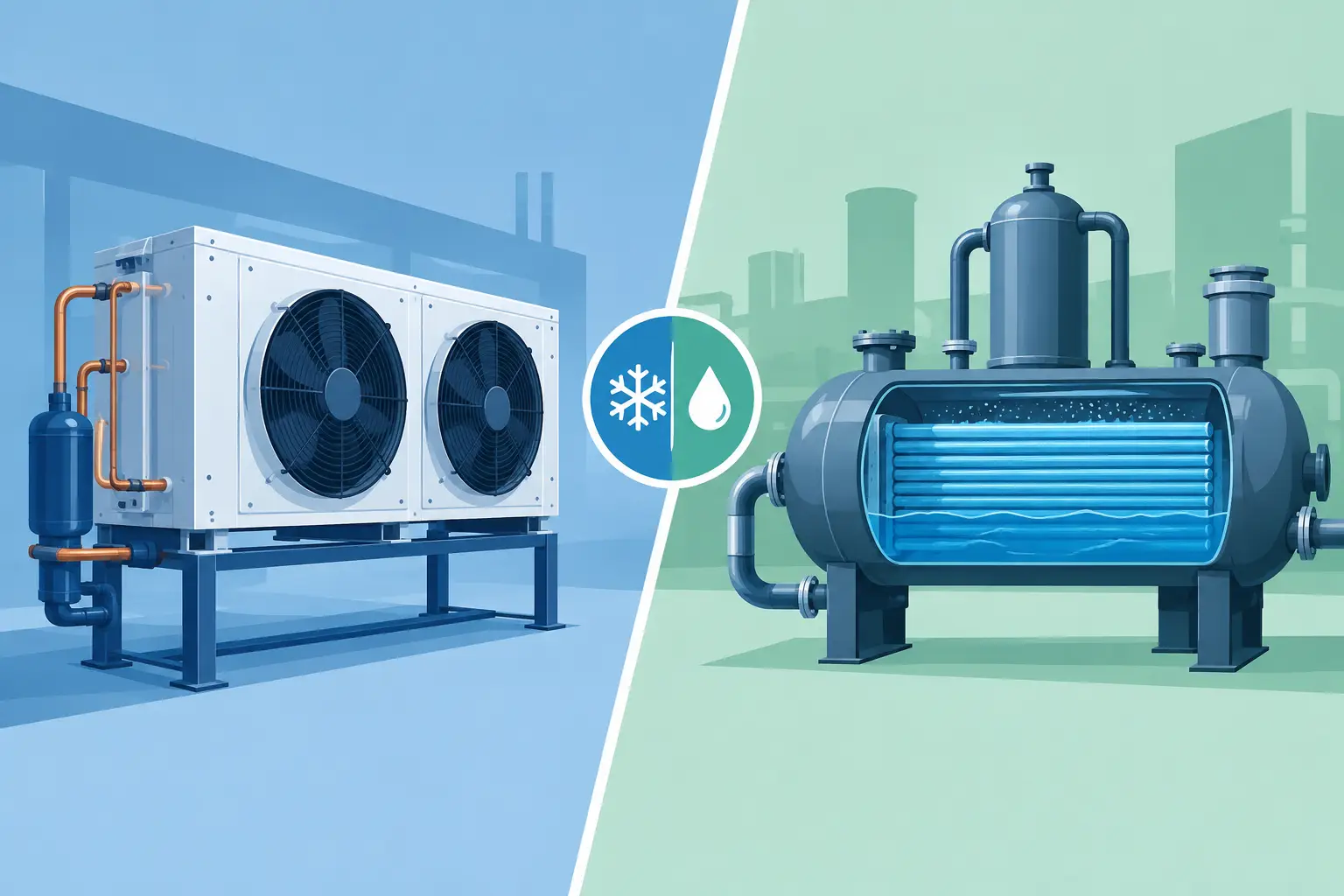
A DX versus flooded evaporator decision is not a choice between a simple coil and a more efficient coil. It is a decision about refrigerant management, control architecture, oil return, charge distribution, and how consistently the heat-transfer surface remains active across the operating envelope. For OEMs and refrigeration engineers, those differences affect both calculated performance and field behavior.
The comparison applies primarily to evaporators. A direct-expansion system meters liquid refrigerant into an evaporator where it evaporates substantially within the coil. A flooded system maintains a liquid refrigerant inventory at the evaporator or feeds the evaporator from a low-pressure vessel, keeping much of the internal surface wetted. Both approaches are established engineering solutions. The appropriate choice depends on the application, refrigerant, capacity range, load profile, and tolerance for system complexity.
DX versus flooded: the fundamental thermal difference
A DX evaporator receives refrigerant through an expansion device, typically a thermostatic expansion valve or electronic expansion valve. The valve reduces pressure and meters refrigerant flow so that the outlet vapor reaches a controlled superheat condition. The coil must perform two functions at once: distribute two-phase refrigerant through its circuits and provide enough downstream surface for superheating vapor before it leaves the evaporator.
That superheat region is necessary for compressor protection, but it does not provide the same local heat-transfer behavior as a wetted two-phase surface. As refrigerant quality rises along a DX circuit, mass flux, pressure drop, refrigerant distribution, circuit geometry, and heat flux all influence the effective evaporating temperature and local heat-transfer coefficient. A calculated DX capacity therefore depends heavily on realistic distributor, circuitry, and expansion-device assumptions.
A flooded evaporator is designed to keep the heat-transfer surface supplied with liquid refrigerant. The vapor generated in the coil separates from entrained liquid in a vessel or separator, while liquid is returned by gravity or recirculated. Because more of the surface operates in two-phase evaporation, the coil can often operate with a smaller refrigerant-side temperature difference for a given duty. That can improve evaporating temperature and compressor-system efficiency when the full system is designed around the flooded architecture.
The distinction should not be reduced to “dry coil” versus “wet coil.” A DX coil contains a substantial two-phase region, and a flooded coil can still experience maldistribution, vapor entrainment, or inadequate liquid circulation. The relevant question is how reliably each design maintains the intended refrigerant state at every circuit and under every expected operating condition.
Refrigerant distribution drives DX coil performance
In a DX design, the distributor is an active part of the thermal system rather than a minor piping detail. Unequal feeding among parallel circuits creates unequal outlet superheat, uneven surface utilization, and potentially unstable valve control. One circuit may run starved and highly superheated while another carries excess liquid. An outlet sensor averages the resulting condition and may not reveal the circuit-level imbalance.
This is particularly consequential for multi-circuit evaporators, low-temperature coils, variable-speed compressor systems, and applications with wide load turndown. The pressure drop available across the expansion device must remain sufficient to meter refrigerant and create acceptable distribution. At reduced load or during low condensing-pressure operation, that available pressure drop can become a controlling design constraint.
Accurate DX analysis should account for tube circuitry, feeder lengths, distributor nozzle selection, refrigerant pressure drop, air-side loading, superheat target, and the refrigerant’s thermophysical properties. For refrigerant blends with temperature glide, local saturation temperature is also not constant through the evaporator. Treating the coil with a single average evaporating temperature may be useful for preliminary estimates, but it is not sufficient for design validation.
Flooded designs shift the distribution challenge rather than eliminating it. Liquid must reach all passages with an adequate circulation ratio and without excessive vapor binding. In recirculated systems, the circulation ratio - the mass of liquid supplied relative to the mass evaporated - affects surface wetting, pressure drop, separator loading, and pump requirements. More circulation is not automatically better; excessive flow increases pumping energy and may increase entrainment or control difficulties.
Efficiency potential is real, but system-dependent
Flooded evaporation can provide a thermodynamic advantage because it reduces or eliminates the intentional superheat region inside the evaporator. With more active two-phase surface, the required temperature difference between air or process fluid and refrigerant may decrease. If that enables a higher suction pressure, compressor power can decline for the same refrigeration load.
That advantage must be evaluated at the system level. A pumped recirculation arrangement adds pump power, vessel heat gain, controls, piping, and refrigerant inventory. A low-pressure receiver or accumulator also creates practical layout and service considerations. At modest capacities, the efficiency gain may not justify the capital cost, footprint, or operational complexity.
DX systems often remain the preferred solution where compact packaged equipment, moderate charge, lower first cost, and straightforward installation matter most. Well-designed DX coils can deliver strong performance, especially when electronic expansion control, correct circuitry, and stable operating conditions are available. The engineering objective is not to force a flooded solution into a DX-appropriate application, but to quantify the actual penalty and benefit under the expected duty cycle.
Part-load operation deserves specific attention. A DX system with an electronic expansion valve can maintain superheat across a broad capacity range, but low mass flow can impair distribution and control resolution. Flooded systems can preserve wetted surface at part load, yet vessel level control, circulation behavior, and compressor capacity control must remain coordinated. Neither architecture is inherently immune to part-load degradation.
Controls, oil return, and charge affect design risk
DX control centers on stable superheat. The expansion valve, sensing location, evaporator pressure drop, compressor response, and any suction-line heat exchange influence the control loop. A superheat setpoint that is too low creates liquid-return risk; one that is too high sacrifices active coil surface and capacity. During pull-down, defrost recovery, rapid ambient changes, and compressor staging, a valve that appears acceptable at rating conditions may become unstable.
Flooded control centers on refrigerant inventory and separation. Liquid level must be maintained without allowing excessive carryover into the suction line. The separator or low-pressure receiver must accommodate vapor disengagement and transient inventory changes. In pumped systems, pump differential pressure, minimum flow, liquid quality at the pump inlet, and line routing are part of the operating envelope.
Oil management is another major separator between the two approaches. DX systems generally rely on suction-gas velocity and circuit geometry to return oil to the compressor. Flooded systems require deliberate oil separation and return strategies because lower vapor velocities and vessel inventory can retain oil. The correct solution varies by refrigerant, compressor type, evaporating temperature, and whether the system is gravity flooded or mechanically recirculated.
Refrigerant charge should be evaluated by location as well as total mass. A DX system commonly holds less low-side liquid inventory, which can simplify some packaged applications. Flooded and recirculated systems typically require additional charge in vessels, liquid legs, and piping. Charge reduction is not merely a sustainability or cost objective; it can affect safety classification, receiver sizing, startup behavior, and service procedures.
Selecting the right architecture for the duty
DX is often a strong fit for unit coolers, comfort-cooling equipment, packaged systems, distributed refrigeration cases, and applications where equipment compactness and simpler refrigerant architecture are priorities. It is especially practical when the coil can be circuitized to provide adequate distribution and when control conditions are well defined.
Flooded or recirculated evaporation is frequently justified in larger industrial refrigeration systems, low-temperature process cooling, installations with long evaporator runs, and duties where maximizing evaporating temperature has substantial energy value. It may also be attractive where stable coil utilization under varying thermal load outweighs the added system hardware.
The decision should be based on modeled operating points rather than a single catalog condition. Compare capacity, air-side pressure drop, refrigerant-side pressure drop, outlet superheat, circulation ratio where applicable, compressor power, pump power, charge, and control margins at design, minimum, and part-load conditions. A coil that meets nominal capacity can still create an unacceptable operating risk if distribution or control stability is marginal.
Engineering-grade thermal analysis is valuable because it exposes these interactions before hardware is committed. Tools such as ExCoil support the detailed coil-level calculations needed to assess circuitry, refrigerant conditions, and performance sensitivity rather than relying on a simplified UA estimate alone.
The practical next step is to define the operating envelope before selecting the evaporator concept. When the assumed suction pressure, load variation, refrigerant path, and control limits are explicit, the DX or flooded choice becomes a defensible design decision instead of a rule of thumb.