
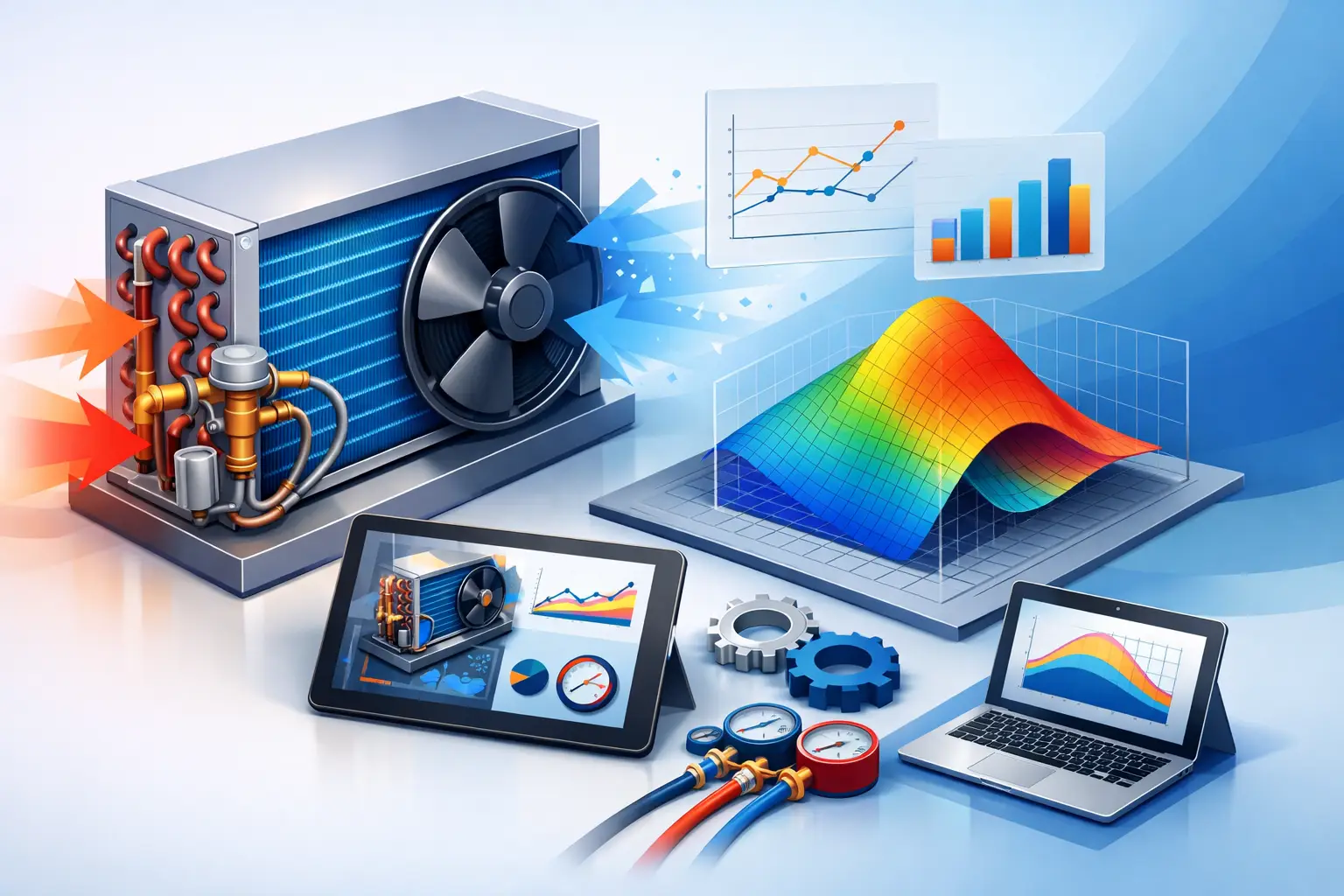
A DX coil that looks acceptable at rating conditions can miss capacity, lose suction quality, or create refrigerant distribution problems as soon as airside temperature, humidity, or circuit loading shifts. That is why dx evaporator performance modeling matters in real engineering work. It is not a paperwork exercise. It is the difference between a coil that merely passes a nominal check and one that performs predictably across the operating map.
For OEM teams, coil designers, and refrigeration engineers, the challenge is that a DX evaporator is not governed by a single heat transfer coefficient or a fixed coil effectiveness. Its behavior changes along the tube length and across the finned surface as refrigerant quality evolves, air properties shift, and wet-surface conditions develop. Any model that smooths those transitions too aggressively will often look stable on paper while hiding the exact failure modes that matter in product development.
What DX evaporator performance modeling must capture
At a minimum, a useful model must resolve three coupled behaviors: refrigerant-side heat transfer, airside heat and mass transfer, and pressure loss. In a direct expansion evaporator, the refrigerant enters as a low-quality two-phase mixture or slightly subcooled liquid, boils through part of the coil, and may leave with a superheated vapor region. Those regimes do not behave the same way, and they should not be treated as though they do.
On the air side, the model must account for sensible and latent transfer. Once the coil surface temperature drops below the entering air dew point, the problem becomes a simultaneous heat-and-mass-transfer calculation rather than a dry-coil temperature change. That transition affects capacity, apparatus dew point behavior, fin efficiency, and leaving-air conditions.
Pressure drop also matters on both sides. Refrigerant pressure loss changes local saturation temperature and therefore local driving temperature difference. Airside pressure drop affects fan power and delivered airflow. If the model predicts capacity without treating these penalties correctly, the result may be mathematically neat but physically incomplete.
Why simplified methods fall short
A single-point coil selection method can be adequate for quick screening, but it is often too coarse for design validation. DX evaporator performance modeling becomes more critical when the engineer needs to understand off-design operation, circuit imbalance risk, frost-sensitive conditions, or the effect of geometry changes such as tube diameter, row depth, fin density, and circuitry arrangement.
The main issue is local variation. Refrigerant distribution is not perfectly uniform. Surface wetting is not always consistent. Circuit loading can differ enough to change outlet superheat circuit by circuit, even if aggregate capacity appears acceptable. Simplified approaches tend to average these effects into one representative condition. That may be convenient, but it can hide unstable superheat behavior, poor refrigerant utilization, or excessive pressure drop in specific circuits.
This is where engineering-grade thermal analysis has value. It lets the engineer inspect the mechanisms behind the performance, not just the final total.
Inputs that drive model quality
The credibility of a model depends first on input quality. Geometry must be defined accurately, including tube pattern, circuiting, fin type, fin pitch, row count, and face area. Small geometry errors can materially alter both UA and pressure drop, especially when the design is already near a limit.
Refrigerant inputs should include the fluid selection, inlet condition, mass flow rate, and expected distribution assumptions. Airside inputs need more than dry-bulb temperature. Entering relative humidity, airflow rate, altitude or pressure basis, and fouling assumptions all affect the result. When the coil is applied in a system model, boundary conditions should also reflect realistic expansion valve behavior and compressor operating conditions rather than idealized nominal values.
The model also needs property methods and correlations that match the refrigerant and geometry range being analyzed. Boiling correlations, dry and wet airside correlations, and friction factor formulations are not interchangeable. An engineer should always ask whether the selected methods are appropriate for internally enhanced tubes, microfin constructions, or specific fin geometries.
How the best models treat the coil
A high-value approach breaks the evaporator into many local calculation elements rather than solving it as one lumped exchanger. Each segment can then evaluate local refrigerant state, air condition, heat transfer coefficient, and pressure loss. That segmented structure is usually necessary for realistic treatment of phase change and wet-coil behavior.
Within each segment, the solver must reconcile coupled variables. Refrigerant pressure affects saturation temperature. Saturation temperature affects surface temperature. Surface temperature determines whether condensation occurs on the air side. Condensation then changes latent load and may alter the effective airside coefficient. These are not independent calculations.
Circuit-level treatment is also important. A coil with multiple parallel circuits may show acceptable total mass flow while still suffering from local starvation or overfeeding. Modeling at the circuit level supports better decisions on distributor selection, feeder sizing, and circuit arrangement.
Performance metrics that actually matter
Capacity is the obvious output, but it is not enough by itself. Sensible capacity, latent capacity, leaving-air temperature, leaving-air humidity, refrigerant outlet superheat, and refrigerant-side pressure drop all belong in the core result set. For many applications, the split between sensible and latent performance is as important as total load.
Engineers should also examine approach temperatures, surface wetness fraction, and circuit outlet variation where available. These values help explain why a coil behaves the way it does. A design that meets nominal total capacity with marginal superheat stability or excessive pressure drop may still be the wrong design.
In refrigeration applications, suction quality and evaporating temperature sensitivity can have significant system consequences. In comfort cooling, leaving-air condition and moisture removal may be the deciding factors. The model should support the decision the engineer actually needs to make, not just produce a rating table.
Where dx evaporator performance modeling creates practical value
The strongest use case is design iteration before prototype commitment. When engineers can compare circuitry options, fin selections, and row-depth changes with credible thermal and hydraulic predictions, they reduce the number of expensive physical test cycles. That does not eliminate lab validation, but it improves what enters the lab.
It also supports off-design assessment. A coil rarely operates only at AHRI-style rating conditions. Ambient variation, fan tolerances, refrigerant glide effects in some blends, and changing suction targets all move the operating point. Good modeling shows whether the design has margin or whether it depends on one narrow condition.
For retrofit or troubleshooting work, the same methods help isolate root causes. If a field coil appears short on capacity, the problem may be airflow, refrigerant feed, surface wetting assumptions, or an underlying geometry mismatch. A model with engineering detail provides a basis for narrowing those possibilities.
Trade-offs engineers should expect
There is no single best evaporator design independent of application. Higher fin density may improve heat transfer area but increase airside pressure drop and make wet-surface performance more sensitive to fouling. More rows can increase capacity but may raise refrigerant pressure loss or create diminishing returns if airflow is limited.
Circuiting is another classic trade-off. More parallel paths can reduce refrigerant pressure drop, but distribution quality can become harder to control. Fewer circuits may improve velocity and boiling behavior in some cases, yet pressure drop and outlet superheat can rise. It depends on refrigerant type, mass flux, expansion device behavior, and the target operating envelope.
The same applies to model complexity. A highly detailed model is not automatically better if the inputs are weak or the intended decision is simple. But if the question involves product validation, geometry optimization, or operating-map confidence, simplified methods usually become the limiting factor.
What to look for in professional HVAC&R software
For technical users, the software should do more than generate a coil output sheet. It should support engineering-grade thermal analysis with enough fidelity to examine local behavior, off-design performance, and geometry effects. Transparent inputs, defensible correlations, and outputs that align with laboratory and product-development workflows are more valuable than visual polish.
This is where specialized tools matter. A platform built specifically for evaporator and condenser analysis is better positioned to represent the actual physics and workflow than a generic calculator intended for broad HVAC use. ExCoil operates in that narrower, technical space because detailed component analysis is a different task from general equipment estimation.
A useful model does not replace engineering judgment. It sharpens it. When the software reflects the thermodynamics, heat transfer, and pressure-drop interactions of the real coil, engineers can make design decisions earlier and with less uncertainty.
The best closing test is simple: if the model helps you understand why the evaporator performs the way it does, not just what total capacity it reports, it is probably serving the work that matters.