
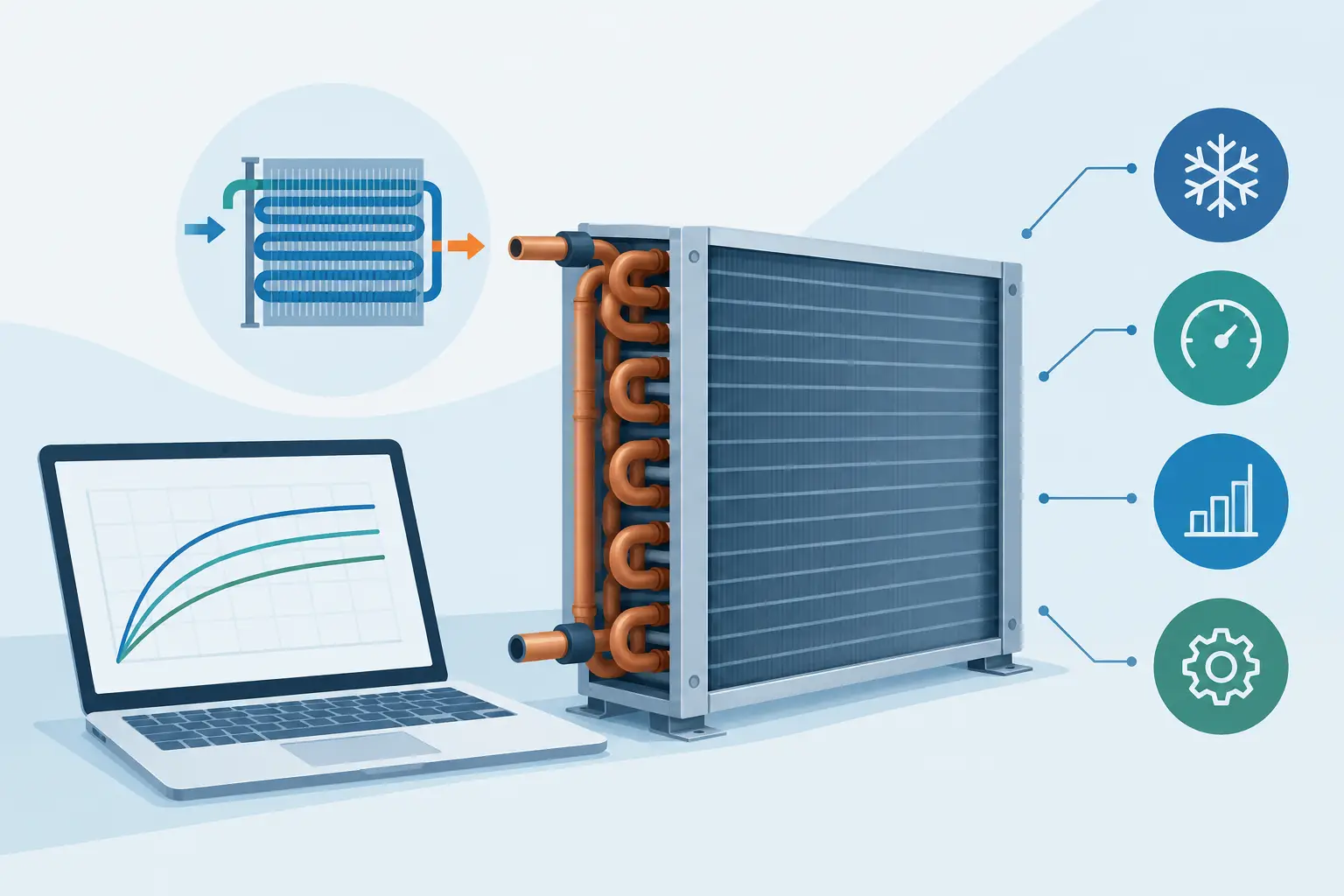
A DX coil rating is only as credible as the boundary conditions behind it. A published capacity at one air temperature, airflow, and refrigerant condition may be useful for selection, but it does not by itself establish performance across the operating envelope. Coil rating methods must reconcile airside heat and moisture transfer, refrigerant-side pressure drop, circuit distribution, fan or face velocity effects, and the rating definition itself.
For evaporators and condensers, the central engineering question is not simply whether a coil can meet a nominal tonnage. It is whether the calculated or measured rating represents the intended duty point with sufficient accuracy to support design release, system matching, or field-performance assessment.
What a Coil Rating Actually Represents
A coil rating is a quantified statement of heat exchanger performance at defined conditions. Depending on the application, the reported result may be total capacity, sensible capacity, latent capacity, refrigerant-side pressure drop, airside pressure drop, leaving-air condition, condensing capacity, or a combination of these values.
The definition matters because capacity can be reported on different bases. An evaporator may be rated by airside enthalpy change, refrigerant enthalpy rise, or a reconciled value derived from both measurements. A condenser may be rated by refrigerant enthalpy reduction or airside heat gain. Those approaches should agree within the uncertainty of the test or calculation, but they are not automatically interchangeable when fan heat, heat leakage, condensate effects, or measurement error are material.
A useful rating therefore identifies the coil geometry, refrigerant, circuitry, inlet air state, air quantity, entering refrigerant condition, superheat or subcooling convention, and any relevant fan or cabinet boundary. Without that information, a capacity number has limited engineering value.
Primary Coil Rating Methods
Controlled calorimeter or psychrometric testing
Laboratory testing remains the reference method when a design must be validated against physical hardware. A controlled test facility establishes air temperature, humidity, flow rate, refrigerant condition, and external heat balance. Capacity can then be calculated from measured airside and refrigerant-side energy balances.
For an evaporator, the airside method commonly uses the change in moist-air enthalpy across the coil. This captures total cooling, including latent load, provided entering and leaving air measurements are representative and condensate handling is properly accounted for. The refrigerant-side method uses mass flow rate and the enthalpy difference between coil inlet and outlet. Agreement between the two is a critical data-quality check.
For condensers, the airside calculation uses the sensible enthalpy increase of the air stream, while the refrigerant-side calculation tracks desuperheating, condensation, and subcooling. Accurate refrigerant property evaluation is essential, particularly near the saturation region where small pressure errors can affect inferred enthalpy.
Physical testing has a clear advantage: it captures effects that are difficult to represent fully, including maldistribution, local bypass, fin manufacturing variation, and circuit-specific behavior. Its limitation is coverage. Testing every geometry, refrigerant, airflow, and ambient condition is expensive, so measured data usually anchor a broader modeling or map-generation process.
Steady-state analytical and numerical models
A detailed thermal model predicts coil performance by dividing the heat exchanger into small elements or control volumes. Each element evaluates local air conditions, refrigerant state, heat transfer coefficients, fin efficiency, pressure drop, and phase-change behavior. The outlet condition of one element becomes the inlet condition for the next.
This segmented approach is particularly valuable for DX coils because the refrigerant does not remain in one thermal regime. An evaporator may contain two-phase evaporation followed by superheated vapor. A condenser may include superheated vapor cooling, two-phase condensation, and liquid subcooling. Circuit geometry determines how these regions occupy the coil and how they interact with the air temperature profile.
A credible model also treats the airside as more than a fixed heat transfer coefficient. Face velocity changes airside pressure drop and heat transfer, while wet-surface operation changes the relationship between sensible and latent transfer. For evaporators, the model must account for dew-point conditions and surface wetness rather than assuming that all capacity is sensible.
Engineering-grade thermal analysis software, such as ExCoil, is designed for this type of component-level calculation. Its value is not a single capacity estimate, but the ability to evaluate how geometry, circuitry, refrigerant conditions, and airflow alter the rating before physical prototypes are committed.
Empirical rating maps and curve fits
Manufacturers often need fast estimates for product selection, system simulation, or controls development. In those cases, rating maps or regression equations can interpolate performance from measured or modeled data. A map may express capacity, power, pressure drop, or leaving condition as a function of entering-air temperature, humidity, airflow, suction condition, condensing condition, and compressor speed.
This method is efficient, but its validity is bounded by the dataset used to create it. Extrapolating beyond the tested or modeled envelope can produce implausible results, especially where capacity changes sharply with air moisture, refrigerant distribution, or approach temperature. A curve fit should be treated as a representation of known performance, not as a substitute for heat exchanger physics.
Inputs That Control Rating Quality
The largest rating errors often originate in inputs rather than in the solution method. Airflow deserves particular attention. Nominal airflow is not the same as actual coil airflow after cabinet losses, filters, dampers, fan operating point, or nonuniform velocity distribution are considered. A coil may receive the correct total airflow while still performing differently because part of the face is starved and another part is overfed.
Refrigerant conditions must be specified with equal care. For evaporators, entering quality or inlet enthalpy, refrigerant mass flow, outlet superheat target, and saturation pressure establish the thermal duty. For condensers, inlet discharge condition, mass flow, condensing pressure, and required subcooling are similarly decisive. Stating only an evaporating or condensing temperature leaves key boundary conditions undefined.
Coil geometry is also inseparable from the rating method. Tube diameter, fin density, fin pattern, row count, circuit count, tube length, and circuit arrangement affect both heat transfer and pressure drop. Two coils with the same face area and nominal capacity can behave very differently when refrigerant distribution or airside resistance changes.
Reconciling Energy Balances and Uncertainty
A professional rating process should include an energy-balance check. If airside and refrigerant-side capacities disagree beyond the expected uncertainty, the result requires investigation rather than averaging by default. The discrepancy may indicate airflow measurement error, sensor placement issues, refrigerant mass-flow uncertainty, unaccounted fan heat, heat gain through the test enclosure, or condensate measurement errors.
Uncertainty should be considered at the level of the final decision. A 2% capacity uncertainty may be acceptable for comparative design screening but insufficient for certifying a product margin near a contractual threshold. The same applies to pressure drop. A modest absolute error can be consequential when it shifts compressor operating conditions or reduces available superheat control margin.
Repeatability is equally important. A test point that cannot be reproduced after stabilization, instrumentation checks, and controlled setup changes is not a strong calibration point for a model or rating map. Establishing repeatable operating conditions is often more valuable than collecting a large volume of loosely controlled data.
Choosing the Appropriate Method
The appropriate method depends on the decision being made. Early concept work benefits from a validated segmented model because it can rapidly compare circuits, fin patterns, and operating conditions. Prototype release requires laboratory data to confirm that the manufactured coil behaves as intended. Product-selection tools benefit from rating maps once those maps are bounded by validated test or model results.
No method should be judged in isolation. A numerical model without calibration can miss manufacturing or distribution effects. A laboratory test at a single point cannot establish off-design behavior. A curve fit can be accurate within its source data while failing outside it. The strongest workflow uses each method for the part of the problem it can answer reliably.
Rating at Off-Design Conditions
Nominal ratings can conceal the conditions where system risk is highest. Evaporators may face reduced airflow, elevated entering-air humidity, low suction pressure, or uneven distributor feeding. Condensers may operate at high ambient temperature, reduced fan performance, or varying subcooling requirements. These conditions change local temperature differences, phase-region length, and pressure losses.
Off-design analysis should therefore examine performance maps rather than a single rated point. Engineers should look for capacity fade, excessive airside or refrigerant-side pressure drop, loss of latent capacity, unacceptable outlet superheat, and signs that circuiting is no longer using the available surface effectively. The goal is not to produce a favorable catalog number. It is to understand the coil's operating margin when the system departs from nominal conditions.
A defensible coil rating begins with a clearly defined duty point and ends with an honest statement of its limits. When test data, thermal modeling, and uncertainty checks point in the same direction, the rating becomes a practical engineering basis for the next design decision.